Even before the start of Russia’s full-scale invasion of Ukraine, security forces in the “DNR” and “LNR” — the Kremlin-created Donetsk and Luhansk “People’s Republics” — were actively abducting and torturing Ukrainian citizens. This past October, as part of another prisoner exchange, Ukraine secured the return of 185 people. Those coming home included not only soldiers, but also civilian detainees who spent several years in Russian custody. Human rights groups do not have precise data on how many Ukrainian civilians passed through Russian prisons before 2022, but over the past three years alone, according to various estimates, their number has ranged from 15,000 to 38,000 people. Ukrainian women who returned from Russian captivity in various exchanges over the course of the war told The Insider what they endured, and how the start of the full-scale Russian invasion made their lives in captivity even worse.
“My entire body was pitch black, and I thought, maybe it's dirt? But those were bruises”
Before the war, Lyudmila lived in Novoazovsk, in Ukraine’s Donetsk Region. In 2014, when Russia-backed “separatists” seized the city of Donetsk and parts of the surrounding area, she began caring for orphaned children from a local boarding school. Lyudmila was arrested in October 2019, she was arrested and first did time in a special detention facility run by the DNR MGB then in Izolyatsia, and later in Donetsk Pretrial Detention Center No. 5. In total, she spent just over three years in custody. Lyudmila was released in a prisoner exchange in October 2022.
* * *
The first half of 2014 was chaos — nobody understood anything. Russian military equipment was still being concealed, but a curfew had already been imposed so that no one would see it being moved. Still, we all heard it — the rumble went on every night. At that time, Ukrainian television was still broadcasting, saying the issue was being resolved, but no one knew what would come next.
The reason we did not leave was the boarding school. It was disbanded, and the children — most of them with mild intellectual disabilities — were first placed with families and then sent to study at a single school in the village of Prymorske. The children there were in terrible condition — hungry, frighteningly thin, poorly clothed, wearing torn shoes.
I told my friend, a journalist, about them, and she came to see me from Kyiv, passing through checkpoints. She brought children’s toys and New Year costumes. In December 2014, the two of us went to see those children, and that was when we decided to help them. My friend in Kyiv sent clothes to Mariupol, and I traveled there across the line of separation, picked up the parcels, and brought them to the school.
In addition to clothes, I always brought Ukrainian-language books and postcards signed in Ukrainian. Of course, I hid all of this — it was impossible to take anything like that through checkpoints. The children also understood that the postcards had to be hidden. It mattered to them. And it mattered to me to tell these children that Aunt Olya or Aunt Lena from Kyiv, Kharkiv, or Poltava loved them and believed that everything would be all right. By that point, the children were already being pressured with propaganda — they were being told that Ukraine was shelling them and wanted to kill them.
I and everyone around me never hid our loyalty to Ukraine. Every year we celebrated Independence Day, we gathered for Vyshyvanka Day. We raised our children with the understanding that they were Ukrainians.
All of this went on from 2014 to 2019. There were several occasions when I was warned — people would come up to me and say that I needed to leave. I knew I had been on their hook from the first day of the occupation. They had files on everyone with a pro-Ukrainian position, but I didn’t take it too seriously. I thought, ‘I’m not killing anyone, I’m not a terrorist, I’m not transporting weapons. I’m just helping children.’
I was arrested in 2019 for those very Ukrainian books that I brought to the children. Of course, when I traveled to Mariupol, which at the time was still under Ukrainian control, I did not just pick up things for the children — I also passed something on to our soldiers. There were several people like me in our city. We had a ritual. At Easter, we always baked pasky — traditional Ukrainian Easter bread — and took them to Ukrainian soldiers in Mariupol. And volunteers in Mariupol also baked pasky, and I brought them to the children. For me, that exchange of Easter bread was symbolic.
On one of those trips, I was given a Ukrainian flag with the inscription ‘To the patriots of Novoazovsk.’ I brought it back to the occupied city and hid it, but before that I took a photo and showed it to friends. Somehow that photo later surfaced, and it, too, became one of the reasons for my arrest. They searched for the flag for a long time and tortured me, but they never found it. I did not give up the place where it was hidden. That flag is still in its hiding place, in my still-occupied city, and I believe the time will come when I will retrieve it.
They searched for the Ukrainian flag for a long time and tortured me, but they never found it. I did not give up the place where it was hidden. I believe the time will come when I will retrieve it
I was detained in the morning. They explained nothing and took me to the local branch of the MGB. They went through my phone, then they brought me to my home for a search and turned the entire place upside down. They pulled Ukrainian books off the shelves and threw them on the floor, mocking me, saying, ‘There you go, you’re Ukrainian! A khokhol woman.’ I realized they were looking for that flag, but instead they found an ordinary Ukrainian flag. Even then, they began pushing me roughly, though they had not started beating me yet. Then they put me in a car, and I thought they were taking me to be deported. On the way, they put handcuffs on me and pulled a bag over my head, and several hours later they brought me to Izolyatsia.
At that point, I still did not understand where I was. I only heard the clang of gates and men’s voices. They took off the handcuffs and ordered me to undress. They turned me to face the wall, laughed, made comments. Someone touched me. I do not know how long it lasted. Then one of the men who had detained me said, “All right, we don’t have time, take her away.” They gave me my clothes back — my shoes no longer had laces, and there was no belt on my pants.
I somehow got dressed, and they put the handcuffs back on me. That was when they began slamming me against the walls. I stumbled, fell, got up, and fell again. Then they simply started kicking me to make me stand up. After that, they threw me against the wall again. That was how they entertained themselves. It was painful and terrifying, and I had no idea what would happen next.
Then they threw me into a cell. I fell and lay on the concrete floor. There was a young woman in the cell. She said, ‘You can take the bag off your head.’ I just lay there on the floor and cried. She said we were not allowed to lie down or sit, that we had to stand from six in the morning until ten at night. Those were the rules.
She showed me the upper bunk, and from 10 p.m. to 6 a.m. I was supposed to lie there without getting up. She said that whenever the door or the food hatch opened, I had to immediately put the bag back over my head and turn away. She added that we were under constant surveillance by a video camera hanging in the corner, and that if I did not stand up right then, things would get worse.
Those tears were the first and the last. I made myself a promise that I would never cry again. I imagined them watching, laughing, taking pleasure in the fact that they were breaking me — and I realized that I would not let them do it. To this day — after three years in captivity and three years in freedom — I do not cry. I simply have no tears.
To this day — after three years in captivity and three years in freedom — I do not cry. I simply have no tears
I understood that I would not become like them, that I would not humiliate myself. This was not my humiliation — it was theirs, their disgrace.
There were several moments when I did not want to live. Later, already in Donetsk Pretrial Detention Center, there were times when I would lie down and think, ‘God, make it so that I do not wake up, because I can’t go on, I have no strength.’ I survived, and now, in freedom, I live through that captivity every second. I understand that there are still women there — a lot of them — who are in the same condition I was in. It is pain, and fear, and hope, and despair, and faith, and disbelief. I need them to come back and for this horror to end. Perhaps then I will be able to exhale, to free myself. And perhaps then I will cry.
I was held in Izolyatsia for 50 days. The worst were the first four days. After the “intake,” they did not take me out anywhere and did not touch me, but they deliberately knocked on the door to make me put the bag over my head. They were probably having fun.
All that time I heard terrible screams. I heard neighboring doors open — most often, men were taken out from there. The most horrifying moment was when one man was brought out and deliberately shoved into the wall so that he fell. He was dragged, beaten with rifle butts, and kicked. And he screamed.
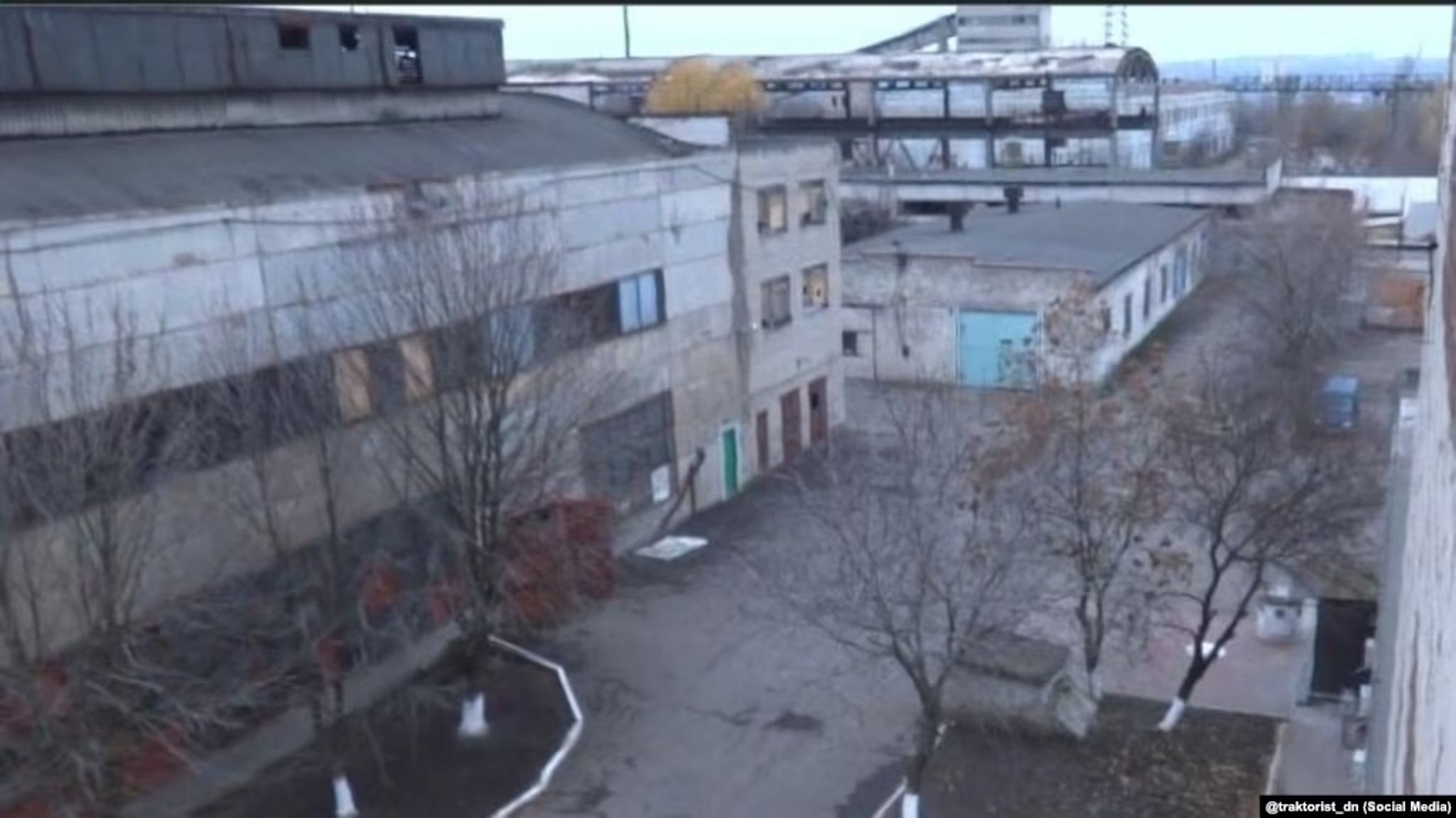
There was a cafeteria on the prison grounds, and beneath it a basement where the torture chamber was located, and they took him there. For two hours, until he was brought back, I sat there unable to breathe. And then I heard them dragging him back, and he was completely silent. He was unconscious. Your hearing becomes extremely sharp, because for the most part you see nothing — the windows are painted over with white paint, and there is a bag over your head. You hear a body being dragged, and it is terrifying.
I was also terribly afraid that I would hear the voices of someone I knew — friends or relatives — because I knew that people were taken away as entire families. I thought it would be better if they cut me, tortured me for days on end, as long as they did not take my loved ones. But, thank God, I was spared that ordeal.
My family did not know where I was. My sister was advised to hire a lawyer, and about a month after she did, I was taken to an investigator. I was very afraid, because people said they did not allow lawyers, that they beat you until you refused legal assistance. But the lawyer managed to reach an arrangement with them, though he immediately said he would not be able to defend me in legal terms.
He told me that my family in Ukraine had already submitted my details for a prisoner exchange and that I needed to “sign everything” as quickly as possible. Then, he said, there would be a trial and I would be exchanged quickly. I said I did not mind signing, but I did not know what to sign. No charges had been presented to me. He explained that I was being accused of extremism — of not recognizing the authorities and the state borders.
I asked him to help arrange my transfer to any other place, because terrifying things had begun to happen in Izolyatsia. I understood that I would not survive. He promised to do everything possible to have me transferred and said he would ask them not to abuse me, since I was ready to sign everything.
After 50 days, I was transferred to Donetsk Pretrial Detention Center No. 5, but no exchange followed. Every six months I was taken to the investigator, and he told me that a new charge had appeared. Once I asked which one, and I was beaten. I never asked again.
I was held in cell No. 1810. It was the worst cell in the entire Donetsk prison. It held convicted criminals — women detained for murder, drugs.
Because it was a cell for people convicted on criminal charges, there were constant confrontations: fights, hysterics, withdrawal, and people harming themselves. The lights were kept on all the time, and the television blared around the clock, broadcasting local propaganda channels or chanson music. It was completely impossible to sleep there, because at night life only intensified. My sister sent me earplugs — I was practically pushing them into my brain — but they did not help. My sleep has still not stabilized.
There was no shower in the cell, and no toilet — just a hole in the floor covered with a bottle to reduce the stench and keep rats from jumping out. There was no ventilation, and the women smoked constantly. Cockroaches and bedbugs crawled everywhere in swarms. There was very little space. When everyone stood up for roll call, they could not fit in a single line and had to stand sideways. Exercise periods, if they happened at all, were rare — and even then, they were on the roof, in the same foul-smelling cells. Visits were prohibited.
There was no shower in the cell, and no toilet — just a hole in the floor covered with a bottle to reduce the stench and keep rats from jumping out
There was no proper food and no water. Drinking water could be obtained only through parcels. My sister brought me packages, but they were limited, and sometimes the deliveries were “frozen” altogether.
For the first year, I lived with the hope of an exchange. In November 2019, I was transferred from Izolyatsia to Donetsk Pretrial Detention Center. I arrived in a state of euphoria — despite all the horrific surroundings, I believed that I would be exchanged before the New Year. I told myself, “I can endure a month.”
I remember that when I arrived, I started changing clothes, and even those criminal inmates, looking at me, said, ‘Wow, they really worked you over.’ That was when I saw that my entire body was pitch black, and I did not feel any pain. I thought, “Where did this come from? Maybe it’s dirt…” But they were bruises.
I made it through to the New Year, and then it became harder. There was an order to “work me over.” In the cell there were women who had served in militias on the Russian side — they had been arrested for weapons trafficking. One of them had been jailed for killing locals so brutally that even her own side locked her up. And they were supposed to beat me.
About a year before my release, another political detainee, Olya, was thrown into the cell with us. She was transferred there as punishment, and she had a breakdown. At that time, the cell boss was a woman convicted of murder, and she said to her, ‘Welcome to hell!’ Everyone laughed. Guards and the shift supervisor came in, and they laughed too. I will never forget how Olya crouched by the hole that served as a toilet and sobbed. After the guards left, I went up to the cell boss, gave her a carton of cigarettes, and asked her not to touch Olya physically, because there was an order to “work her over,” and by then I already knew what that meant.
By that point, I had already gained a certain authority. They called me a “crazy khokhol woman,” because nothing broke me. They often came up to me and said that I needed to be “worked over,” but that they would not hurt me too badly — just, they said, that they had to show I had been beaten, because someone was watching.
Once I tried to pull Olya away, and someone slammed me against the metal bunks. My ear turned completely black — half my face, too – and the same happened to her. I said to her, ‘Imagine there’s an exchange tomorrow. I won’t be able to appear in front of my family looking like this,’ and we both had hysterics. The others did not understand what had happened and thought we had gone crazy. The cell boss came over and asked, ‘Have you lost your minds?’ I said to her, ‘What if there’s an exchange tomorrow — how are we supposed to go out like this?’ And then all the criminal inmates started laughing.
Once someone lunged at me with a shiv, and what saved me was that without my glasses I simply did not see it. Some kind of argument broke out, and one of the cell bosses came at me. I looked around — the entire cell had gone quiet and was watching. There was a long iron table between us — the communal table. She was on one side of it, and I was on the other. She walked around it and came right up to me with that shiv, looked at me and said, ‘I don’t get it — are you completely crazy? Aren’t you afraid of me at all?’ I said, ‘Why should I be afraid of you?’ She cursed and threw the shiv onto the table. Only afterward did I realize it had been a shiv. If I had shown fear, she would have stabbed me. Perhaps that was the moment I became the “crazy khokhol woman” to them, and it became a lesson for me — you must not show that you are afraid.
For me, it became a lesson — you must not show that you are afraid
Occasionally, we were taken to a makeshift bathhouse in the basement. Men with German shepherds stood there and set the dogs on people — that was how they entertained themselves. You had to undress in one room and then run naked into another where the showers were. The guards watched us constantly and commented on everything. You were given five minutes to wash. The shower stalls were small, and there were only two or three working showerheads, with water barely trickling out. A lot of people were brought out of the cells at once, and you simply did not have time to wash. Rats ran around there, and they were so unafraid of people that sometimes you had to fend them off with plastic basins. They did not attack, but they ran between your legs, which was, to put it mildly, extremely unpleasant.
When a violent fight broke out in our criminal cell, or when someone overdosed on drugs, or when someone cut their veins or stomach, the entire cell was punished.
There were several types of punishment. One was a “freeze” of the cell — parcels were banned, we were not taken to the roof, and even the thin, foul-smelling mattresses were taken away, forcing us to sit on bare iron bunks, which were poorly welded and uneven. In winter, it was very cold to sit on them, because the cell was not heated. Another punishment was being “taken to the chair” — a special chair that rang if there was anything foreign inside your body. But this did not always work, because women who hid things in their vaginas — phones or drugs — knew how to sit in a way that made nothing ring. Then a female guard, in the presence of men, would put on filthy rubber gloves and, one by one, insert her hand into every woman’s vagina.
From time to time, I was taken to see the investigator in another building. They put handcuffs on me, pulled a bag over my head, and loaded me into a prison transport van. Sometimes there was an iron bench inside where you could sit. Other times there were cages where you could only stand. Several people were crammed into one cage, so there was nothing to breathe. They shoved you so that you would slam into the vehicle or fall, then they hauled you back up with rifle butts or batons.
The investigator also liked to mock me. When they brought me into his office, he allowed them to remove the bag from my head, but the handcuffs stayed on. He would then disdainfully pull out a handkerchief and say, ‘My God, you stink.’ It was true: there was no air in the cell, we did not wash, human waste stank, and bedbugs crawled all over me. When someone entered his office, he would say, ‘Don’t go near her — she’s crawling with bedbugs. She stinks.’ He humiliated me deliberately. Sometimes someone would come up from behind and hit me with a baton for no reason — on the head, on the back. They laughed, saying, ‘Nobody’s even touching you.’
In December 2021, the investigator and the man who had arrested me suddenly came for me. I was surprised, because before the New Year there is usually no movement in the prison, and I thought it might be an exchange. But they told me not to take anything with me. The man who arrested me shouted at me, swearing, saying that all my female friends would now be sent along the prison transfer route. Then they summoned a lawyer. He said that they were now urgently going to close my case, and since they had conducted no investigation at all for two years, they needed to write all the reports retroactively, starting from the first day of my arrest. When they left and I was able to stay alone with the lawyer for literally a minute, he told me that in Ukraine I had been awarded a human rights prize and that an order had come from above to urgently send my case to court.
That was when I first saw all those reports. They did not let me read anything — only sign. Sometimes I pretended to be looking for where to put my signature and tried to read something. I saw that my case contained six denunciations and that I had been under surveillance when I traveled to Mariupol.
They sent my case to court. Then a ruling came from the Supreme Court: the article under which I was charged carried the highest possible penalty — execution by firing squad — but since a moratorium on the death penalty for women was in effect in the DNR, my case would be postponed for the time being.
Until the summer, they left me alone. In the summer, I was summoned to a pseudo-hearing on prison grounds — several women were sitting there. I was charged under four articles and asked whether I agreed with the accusations. I said that I agreed with the charge of extremism, because I do not recognize this authority. But I did not agree with the espionage charges, because there was no evidence that I had been a spy. When asked whether physical violence had been used against me, I refused to answer. The lawyer later said that this had been the right decision — otherwise, the case could have been sent back for additional investigation to the same people who had beaten me. And then they would not have held back.
In the fall of 2022, there was a referendum on the annexation of the occupied territories. We were taken to a special room where there was a lawyer and two guards with batons. On the table were two stacks of ballots — one already filled out, the other blank — and they forced us to sign where it said “in favor.” I marked “against,” and for that I was beaten by the guards. After me, Olya went in and also voted against, and then came out of that room in tears. I know that two other women also marked “against,” and the rest voted “in favor.” Everyone was afraid. They threatened me that they would either throw me into the basement, or send me back to Izolyatsia, or transfer me to a Russian prison — and then, they said, I would understand what a “real” prison was.
I was threatened with being taken to a Russian prison, and told that then I would understand what a “real” prison was
On October 15, 2022, the cell door opened and my last name was called. I was told to take everything essential. I thought this was a transfer and that I would be sent somewhere into the middle of nowhere in Russian, to Siberia. No one explained anything. Several other women were taken out along with me, and we were moved to another building. There were women there who were prisoners of war. We were placed together in a cell, and then they began taking the POWs out one by one.
Through a crack, we saw that there was a camera set up there. The POWs were forced to give their first and last names, their military unit, and to sing the Russian national anthem. One woman got confused and forgot the words. They began beating her, then threw her into a neighboring cell and said, ‘That’s where your journey ends.’ She screamed terribly, pounded on the doors, and begged to be given another chance. In the end, they allowed her to sing again, and she sang very clearly and loudly.
I was extremely anxious, because I did not know that anthem at all. I understood that I might break down and refuse to do it. But we were not forced to sing the Russian anthem. We were taken out and told to sign some logs. After that, our hands and eyes were bound with tape, and we were thrown into a truck.
They drove us around for a long time and eventually brought us back to the same prison. When someone asked why they were doing this, we were told that we were now being taken to the basement to be shot. They said it and started laughing. They put bags over our heads and led us into the basement. Everyone was terrified. Some people were crying.
In the basement, they threw us into a cell. There were already 14 women there, and the cell had only eight bunks. There were no blankets, no mattresses — nothing. It was very cold and damp. One of the women asked for food, and they said, ‘Why feed you for nothing? You’ll be shot anyway tonight.’
One of the women asked for food, and they said, ‘Why feed you for nothing? You’ll be shot anyway tonight’
In the morning, they threw two loaves of bread into the cell and gave us some diluted tea — literally a few sips each. Then they wrapped our hands and eyes with tape again, loaded us into a vehicle, and drove us for a long time. Eventually the vehicle stopped. A man got in with us and said, ‘Relax, you’re on Russian territory now, and your life is changing.’ Then we stopped again, and he said we would spend the night in the vehicle until morning. He allowed us to peel the tape back slightly from our eyes.
In the morning, he said that it was going to hurt now, but that ‘it’s better if I do it.’ He went around and tightly rewound the tape over our eyes. It really was painful — it felt as though my head was about to burst. Then the vehicle doors were opened. Other people took over, shouting obscenities and very roughly pushing us out of the vehicle so that we fell to the ground. They threw us somewhere and forced us to sit down on something — we could only feel a metal floor. They just told us to sit and spread our legs, and we sat back to back. If anyone complained, they were beaten with rifle butts.
Then we heard a roar, and it became clear that it was an airplane taking off. When we landed, they began shoving us out just as roughly and beating us with rifle butts. One woman said, ‘I can’t stand up, my legs just won’t work.’ We dragged her along, because we understood that otherwise no one would ever find her.
We were distributed among vehicles. Through a crack, we saw that we were in Dzhankoi, Crimea and realized that we were heading to the Zaporizhzhia Region of Ukraine. When the vehicles stopped, Tatyana Moskalkova, Russia’s human rights commissioner, began approaching each one of us. She was accompanied by television crews. Moskalkova asked whether everyone wanted to return to Ukraine. Of course everyone shouted ‘Yes!’ And then we began moving in columns into the “gray zone.”
A column of men was walking toward us. Later we learned that these were Russian sailors who were being exchanged for us, and they were all clean. They smelled fresh. They looked well-fed. Some of them even had wheeled suitcases. That struck me, of course.
Then we were met. A young man with a white flag said in Ukrainian, ‘Welcome, girls, you are on Ukrainian territory,’ and we began rejoicing and hugging each other. The emotions were indescribable. I was still afraid that it was some kind of dream. But I understood that, for the first time in three years, I was walking on the ground.
“I thought I would not get out, it was despair mixed with hatred”
Natalia lived in the city of Horlivka, in Ukraine’s Donetsk Region, and worked as a mathematics teacher. In July 2021, she was detained by officers of the “DNR MGB.” In total, she spent four years in captivity and returned to Ukraine thanks to the efforts of the Main Intelligence Directorate (HUR) in April 2025.
* * *
I was born in Horlivka, in the Donetsk Region. In 2014, when the invasion of Donbas began, I was against all this “movement,” as Putin calls it. They were taking over our city, our schools, everything. I could not stay silent. I created a Twitter account and began writing about the social and economic situation in my city. Even when I left to work in Kharkiv, I still traveled to the Donetsk Region and wrote about everything. I ran my Twitter account for seven years, from 2014 to 2021.
In July 2021, I went to see my mother. She was due to have leg surgery, and I planned to stay with her. At the Uspenka checkpoint, I was detained and told that I had “been on the wanted list for two years already.” I knew this was a lie — I had traveled before, and no one had stopped me. They took me straight off the bus, along with my belongings. I thought they were just going to check my passport, but they said, ‘Go into the room, the MGB will arrive shortly.’ That was when I realized I was in trouble. They drew up a detention report, said they would take me home, but instead they brought me to Donetsk — to the basement. That was how it all began.
As I later understood, they had been monitoring my posts. I had a radical position: I went to the Maidan, to Vyshyvanka Day events, supported Right Sector. I always had a lot of Ukrainian photos, and they seized on that. In private conversations, they said, ‘You betrayed Russia.’ I replied, ‘Seriously? I have nothing to do with Russia. Horlivka is Ukraine. Donbas is Ukraine.’
I was very afraid, but I did not show it. I thought, ‘Either they’ll kill me for my words, or they’ll kill me anyway — there’s no point begging.’ They shouted, humiliated me, but did not beat me. They kept addressing me informally, and I switched into teacher mode and said, ‘Remind me, from what moment did we switch to informal manner of address?’ One of them flinched and switched to the formal address. He still humiliated and insulted me, but using the formal manner of address.
They charged me with “espionage.” That carries the death penalty. I asked, ‘So are you going to shoot me?’ They said, ‘We don’t shoot people here.’ Then they added extremism charges, calls to overthrow the authorities — in short, they said I would never get out of prison. And I also thought I would not get out. It was despair mixed with hatred.
I spent three months in their basements. They threatened me, shouted, put me through a detector, and deprived me of sleep. Then they took me to a temporary detention facility, where drug users and drunks were held, and I spent a month there. It was brutal, because I had nothing with me — no soap, no toothpaste, no comb. I was wearing only a shirt and shorts, and I just tied my hair into a knot, and that was how it stayed.
Sometimes I was alone in a cell, sometimes with criminal detainees. Dirt was everywhere, and there were no rags to clean with. There were inmates with HIV and with tuberculosis. You would enter a cell and it was simply destroyed. You could not tell when it was day or night. Everywhere there was frosted glass.
There was a video camera in the cell. It was positioned so that even the toilet was visible. There was no toilet paper. There was anger and a constant thought: ‘I have to survive.’
There was anger and a constant thought: ‘I have to survive.’
When they fed us, they made us wash the dishes. I said, ‘How are we supposed to wash them if there’s nothing to wash with?’ And they replied, ‘Then we’ll just serve the food again in these greasy, dirty ones.’
They constantly took me in for interrogations, threatened me, and then, a month later, formally charged me and transferred me to a pretrial detention center. I spent 22 months there.
There were interrogations in the pretrial detention center as well. They asked, ‘Were you forced at school to speak Ukrainian?’ I said, ‘Why would anyone have to force me? I spoke it myself.’ They tried to put the idea into my head that Ukraine had broken me. They even wrote out a text for me on a piece of paper: I was supposed to “repent” before Russians for having lost my way in my beliefs, to say that Ukraine was in fact a monster. I said, ‘Do you even understand what you’re writing? Let me correct it.’ I took the paper and wrote: ‘I chose Ukraine myself. I support Ukraine. Horlivka is Ukraine.’ There were 12 people standing there, all wearing masks, and I thought, ‘Now they’re going to start beating me.’ But one of them simply said, ‘There’s no point talking to her.’
Once, I was filmed for a propaganda video. One man was talking to me — he was from the same town as I was. I knew his mother. He said to me, ‘I’m from Horlivka too, I’m Ukrainian too.’ I replied, ‘Then let’s speak Ukrainian, if you’re Ukrainian.’ They used that phrase in the video, portraying me as a terrorist who wanted to bring back Independence. There was a caption saying that she thinks she is supported there, but no one is waiting for her.
I realized that he had decided to build his career on me — he called me a terrorist, a murderer, then showed photos of some people who were supposedly killed because of me. Later, the investigator told me that they would use that video as evidence of my guilt.
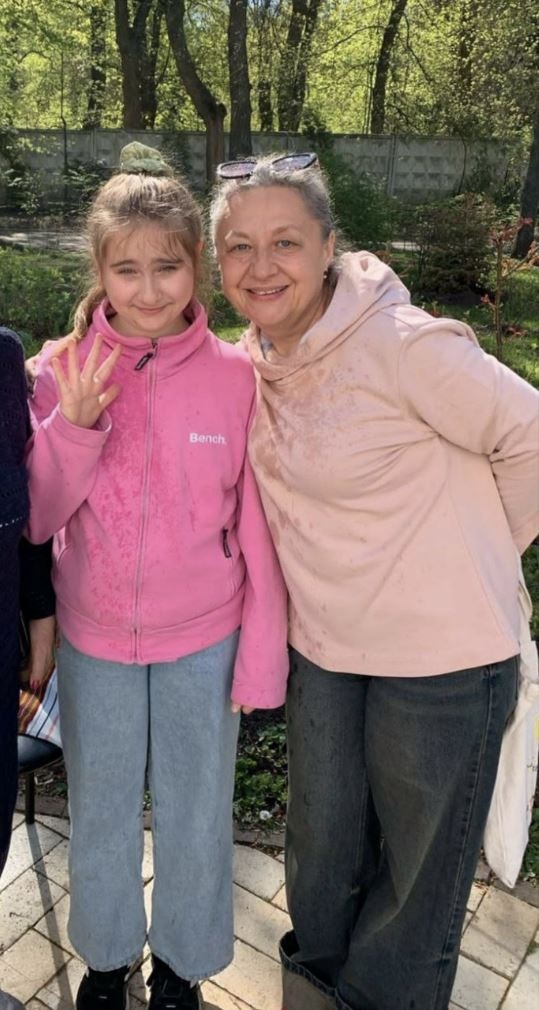
My daughter hired a lawyer for me — one of the five who were allowed to work with political detainees. He told me right away, ‘I won’t be able to get you out, but I’ll be a link to your family.’ I then wrote a note to my mother asking her to send some clothes and food. Until February 2022, the Red Cross sent us hygiene kits. When the full-scale war began, the DNR declared that the Red Cross was a spy organization and said it no longer operated there.
At first, I was held with various criminal detainees, but from the summer of 2023, all of the political prisoners were gathered into one cell. There were 14 of us. There were other cells with political detainees as well. They tried to classify us — one charge per cell. But mostly everyone was local, people who disagreed with the authorities. Some had Russian documents, which meant “treason against the motherland.” I did not have Russian documents, so I was charged with espionage on behalf of Ukraine. They forced us to take Russian passports, but we refused.
The cell was 25 square meters. In the middle, about two square meters were taken up by a table with benches welded to it. There was nowhere to walk. About two square meters was the so-called sanitation area. We separated it with a curtain. The sink was there as well, and that was also where we washed ourselves. We had a basin, heated two kettles of water, and went to wash.
There was no ventilation. Water ran down the walls. But we were afraid of tuberculosis, so we never closed the windows. Frost or heat — it did not matter.
Officially, reveille was at six, but no one bothered us then. We were the last cell in the corridor, and you could hear when someone was coming.
Roll call was at 7 a.m. — we had to get up and stand. They counted everyone. In the mornings, women conducted searches, checking our belongings. There were also surprise searches carried out by men. They took everyone out and searched for something, presumably prohibited items. I did not understand why. Everyone there had higher education — what fights would they get into? But the men turned everything upside down.
In the morning, they gave us what they called milk porridge — milk diluted with water. For lunch there was soup — or, rather, something incomprehensible with very rough chopping. For porridge, it was either millet or barley. For dinner, they gave boiled fish, the cheapest kind. It was boiled exactly as it arrived, in bags with shells, and then they poured that same water for us to drink.
Relatives sent us groats. Buckwheat did not even need to be boiled — you pour boiling water over it, wrap it in a blanket, and it turns out fine. Oatmeal worked the same way. We were given two spoonfuls of sugar for four days and half a loaf of bread per person.
In September they staged a show referendum. We were taken to vote, supposedly on the annexation of the occupied territories. I wrote “no.” I was in prison anyway — what difference did it make what happened? At some point, indifference sets in. First there is fear, then reluctance, then depression. I accepted fate: if I was going to die anyway, why would I support them in anything before my death.
I accepted fate: if I was going to die anyway, why would I support them in anything before my death
When the full-scale war began, they became more aggressive. They started calling us slurs — khokhols, Nazis, ukry. They were in a state of victory euphoria. They tried to humiliate us, saying that we would now rot there for good. I think they did not beat or torture me because in my case they had a different approach — a demonstrative imprisonment. They filmed a propaganda video with me, essentially showing: “Look what happens to people who do not support Russia.”
Do you know what I did to keep from losing my mind? I had a collection of higher mathematics problems in my cell. I solved problems. You immerse yourself in it and stop seeing what is happening around you. We held on as best we could. We drew, solved crosswords, but from time to time everyone withdrew into themselves. It was hard. I would not wish this on anyone.
Eight months later, I had a court hearing. I was taken out for it. My lawyer, the judge, and the investigator were there. I remember the judge asking, ‘On what grounds are you holding her in custody if there are no procedural actions?’ Either they needed to conduct an investigation or release me under house arrest. Two weeks later, I was released under house arrest: I was not allowed to leave my district, use the internet, or communicate with anyone. Everything was monitored.
When I returned to Horlivka, I thought people would spit at me. But it was the opposite. People came up, hugged me, gave me money, brought food. But those who supported the “DNR” walked past and looked away — they were afraid to meet my eyes.
When I returned to Horlivka, I thought people would spit at me. But it was the opposite
Then I tried to leave again, but through a different checkpoint — via Kuibyshevo. I was detained once more, held for questioning for three hours, and sent back to Horlivka. In despair, I recorded a video for my daughter, saying that if I tried to leave again and disappeared, she should know that I had been taken.
My daughter contacted the Ukrainian security services. I did not know this at the time. A man called me and explained what I needed to do, how to behave, and what to say.
I tried to leave a second time — and was detained again. They questioned me, checked my phone. I followed the instructions exactly, and they let me go. The driver who was taking me was in a hurry, and 15 hours later we were already at the Polish border.
They got me out. The only thing they scolded me for was that I had rushed it after three months, when they had advised trying only after six. They said I had been very lucky, and that it could all have ended very differently.
“Black patches spread across my face – from the cold and the beatings”
Alexandra (name changed for security reasons) lived in Novoazovsk. In 2019, she was arrested by the “DNR MGB” for communicating with a relative who was serving in the Ukrainian Armed Forces. In total, she spent nearly six years in captivity. She returned to Ukraine as part of a prisoner exchange in August 2025.
* * *
I often traveled to Mariupol. My sister’s husband worked at a checkpoint, and local residents knew him and had seen him there. Someone filed a denunciation against me. On August 29, 2019, they came to my home, started asking questions about my brother-in-law, carried out a search in front of my children, and then told me to go with them to see an investigator. They took me away and threw me into a basement. I never returned home after that.
I spent five months in the basement — without hygiene supplies, in the cold, almost without clothing. There was only an iron bench, and that was where I slept. They brought spoiled, ice-cold food and rusty water. I tried to drink as little as possible, because there was no toilet inside — they took us outside in the morning and in the evening. In those five months, I was taken to the shower twice.
They brought spoiled, ice-cold food and rusty water. I tried to drink as little as possible, because there was no toilet inside
I still do not understand how I survived those months — the torture, the beatings. I was tortured by having a bag pulled over my head, suffocated, and beaten. They beat me right in front of their lawyer, while the investigator hurled insults. And when I said during interrogations that I was cold and hungry, they stopped feeding me altogether. Black patches appeared on my face — from the cold and the beatings, I suppose. They beat me with their hands and fists. I was very thin — just 47 kilograms.
Once, after I had already spent a couple of weeks in that basement, during one of the interrogations they told me that they were about to take me away and hand me over to twenty men. My God, I was so frightened then. One of the operatives, right in front of me, took a phone, dialed a number, and said, ‘Get a room ready for the girl.’ My heart sank. I dropped to my knees and started saying, ‘What are you doing? You can’t do this! I have two children.’ That was when they first took me to Izolyatsia and threw me into a punishment cell measuring one and a half by one meter. I curled up in the corner and slept sitting up. When they came in with food, I thought they were taking me to be raped. I started trembling with fear, but they simply left the food — that was how they pressured me. They kept me there for two days, and then sent me back to the basement again.
While I was there, I heard the Russian national anthem being sung behind the wall, and it felt like I was in some kind of madhouse. I did not understand what was happening. I heard only the clanging of doors. I imagined that everywhere there were cages, like dog cages, stacked two levels high. It seemed to me that people were being held in those cages.
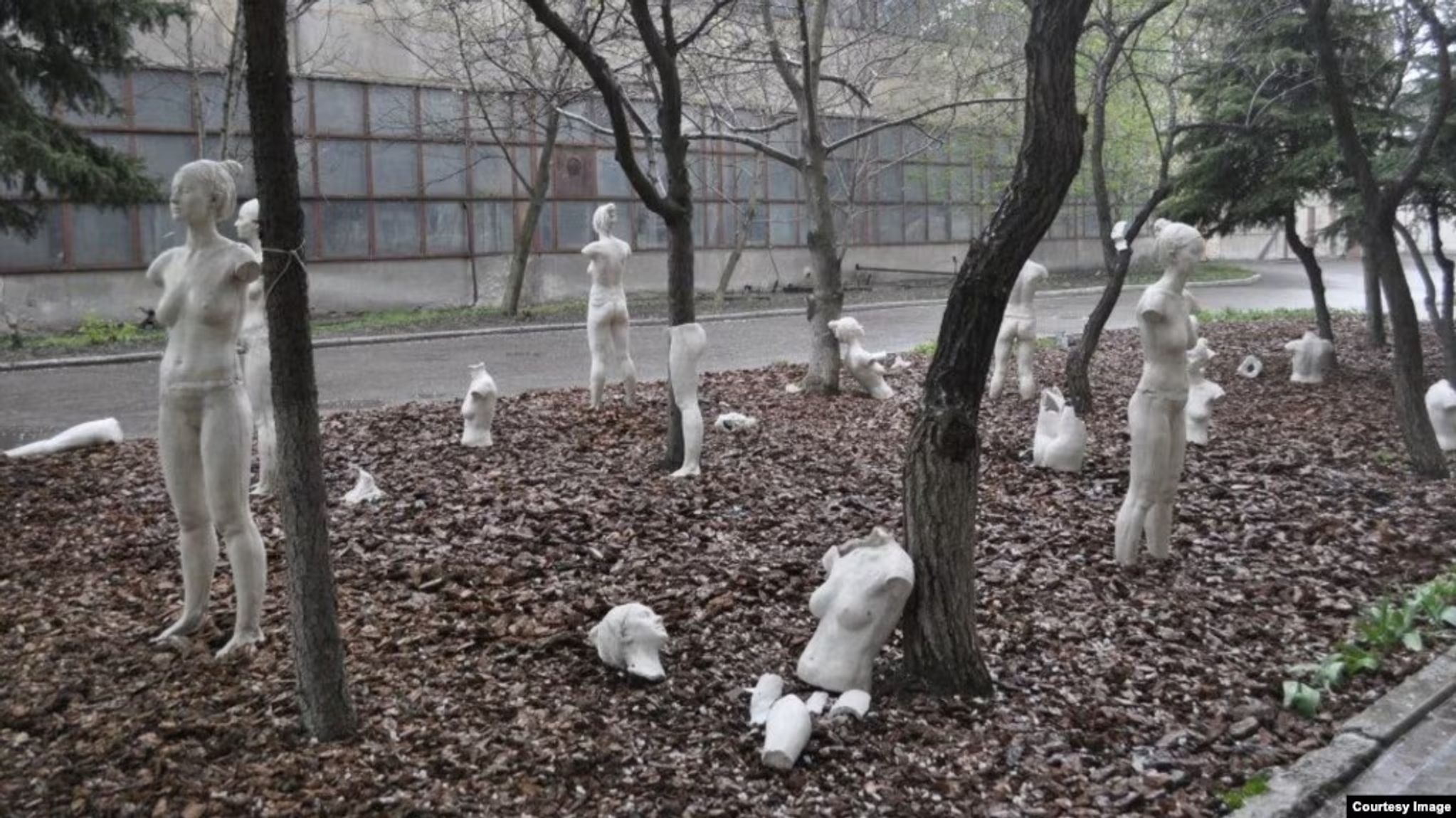
Then I was transferred to Izolyatsia for good. From there, they took me to interrogations at the MGB. There was one operative who oversaw everything there. He beat me constantly, and he was the one who took me to interrogations and court hearings. He would cuff my hands behind my back, put a bag over my head, and then another mask on top. When he pulled me out of the vehicle, he always wrenched my arms upward. It was excruciatingly painful, and from the pain I would drop to my knees. I was wearing jeans with beads, and when I fell to my knees, they dug into my legs. That was also unbearably painful.
I remember him driving me once with the heater turned up so high that I began to suffocate. I asked him to turn it off, but he did not react. It was pouring rain while he was driving, and the car was plowing through puddles. At that moment, a thought flashed through my mind: ‘God, if only we would crash and be smashed to pieces — let it happen, just so this suffering would end.’ At that point, I wanted it desperately, because I no longer had the strength to endure it.
During one of the interrogations, I asked where my children were and what I was being accused of, and I was severely beaten. That operative brought me back to Izolyatsia and beat me again in the hallway. He pinned me against the wall and beat my legs. I fell, and he hauled me back up, shoved me into position again, and slammed my head against the wall. After that beating, they locked me in a punishment cell for three days and did not feed me.
During one of the interrogations, I asked where my children were and what I was being accused of, and I was severely beaten
They brought my belongings from the cell into that punishment cell. Among them I had fish oil and water, and for all three days I survived on that oil. That was how I held on. I felt terrible. After the beatings my head was spinning. The punishment cell was one and a half by one meter. I lay almost on the floor, because the mattress there had no padding and was completely filthy.
I ended up in the punishment cell about four times in total. Otherwise I was kept in a cell with other women. Sleeping there was forbidden. We sat on small stools; lying down was not allowed. God forbid someone closed their eyes — everyone would be punished. Thank God that happened to me only once: because of me, we stood for several hours. But with the men, we heard, it was harsher. If someone closed their eyes or fell asleep sitting up, they were forced to stand with their arms raised overhead or holding a pillow above their head. This was called “holding up the sky,” and it went on for hours.
They were forced to stand with their arms raised overhead or holding a pillow above their head. This was called “holding up the sky”
I still do not understand how I survived all of this. It feels like it was a terrible dream. Sometimes I thought it was all some kind of game — that it was not me, that none of this was happening to me. That this simply cannot exist in real life, do you understand? I had never known anything about torture. Later, when I was transferred to a penal colony in Snezhnoye, I began reading the memoirs of Yevgenia Ginzburg and comparing realities — mine and those of the camps she described.
When they brought me to the colony, I had to strip completely naked and squat. That was how they checked whether you had anything prohibited inside you.
Life there was easier, but you had to work constantly. We sewed from eight in the morning until eight in the evening. I did not want to work alongside murderers. Then they told me, ‘Do you understand that you are in our hands? If you don’t work, your mother will start having problems with the law.’ I understood that to them I was a grain of sand. They could, for example, draw up a report accusing me of an attempted escape and shoot me on the spot.
They threatened us and tried to force us to take Russian passports. There were many criminal inmates who had been brought in from the prisons of destroyed Mariupol. Their documents had burned, so the colony administration assigned charges to them based on the women’s own words and automatically stamped Russian passports for them. I refused. I wrote refusals twice. I was summoned for interrogations, threatened, told that I would not be included in any exchange. For refusing to take a Russian passport, I was first sent to a punishment cell for 15 days, and then to solitary confinement.
Some inmates tried to pressure us because we supported Ukraine. I even got into a fight with one of them. She stood up and started saying, ‘These Ukrainian spies, it’s all because of you….’ I grabbed her and said, ‘Shut up and don’t touch us.’ But there were also those who treated us normally and said about us, ‘They’re the most decent people here.’ But there were very few like that.
I constantly thought about an exchange, even though I no longer really hoped for it. One day we were in the industrial zone, and we were told to urgently go to the medical unit. On the way, we were intercepted by a group of staff and taken to the library. There we signed some documents and were told that Putin had pardoned us and that we were going home. We were told to gather our belongings, but I took almost nothing with me except a toothbrush and toilet paper. I took my photographs and a prayer book, and they put us into a prison van.
They first took us to Makiivka, then to Rostov, followed by three flights. At one of the stops, we were left sitting on a bench outdoors. It was bitterly cold. I took some warm clothes from the woman next to me, and the two of us huddled there like stray dogs, freezing. We were desperately hungry, but we had no food. We were told that our meal boxes had been “lost” on the plane.
In Belarus, they finally removed the tape from our eyes and hands and gave us bags with food and water. From there, we were taken by bus to Chernihiv. And when I arrived in Ukraine, I began to cry.