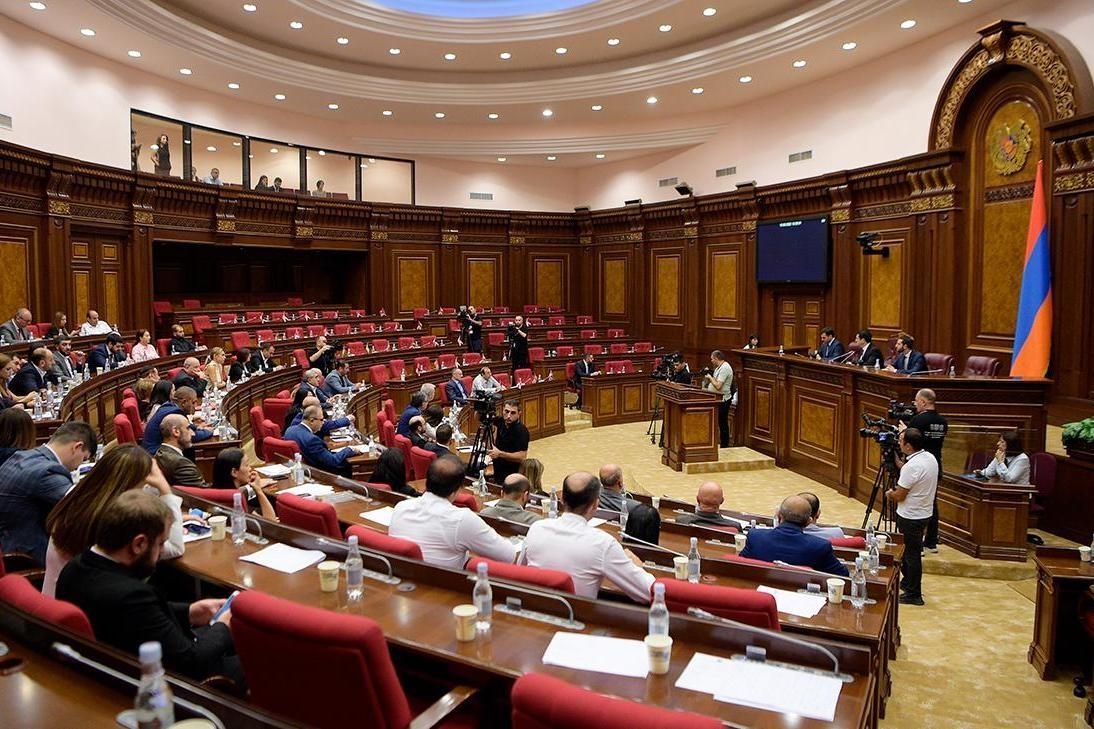
Civil Contract, the party of Armenian Prime Minister Nikol Pashinyan, won the country’s June 7 parliamentary elections, receiving 49.8% of the vote, according to preliminary official results from the Central Electoral Commission in Yerevan.
The Strong Armenia bloc of Russian-Armenian billionaire Samvel Karapetyan came in second with 23.3% of the vote, while the Armenia alliance of former President Robert Kocharyan gained around 10%. The question of whether businessman Gagik Tsarukyan’s Prosperous Armenia party will clear the 4% threshold necessary for securing representation in parliament will remain open until the vote recount is complete.
The remaining 14 parties and blocs failed to clear the threshold, and their votes will be redistributed among the parties that cleared the 4% barrier. As a result, Pashinyan’s Civil Contract will retain a majority in the National Assembly.
On June 8, the Armenian service of Radio Free Europe/Radio Liberty reported that none of the three largest opposition forces had recognized the official election results as of Monday at noon local time. The opposition pointed to numerous alleged violations during the voting and vote-counting process, as well as to the ongoing detentions of opposition supporters on charges of vote-buying.
Electoral analyst Roman Udot notes that certain anomalies working in favor of Pashinyan do exist, but they are minor. “In my personal assessment, there are distortions in favor of Pashinyan — they are not quite what we are used to seeing in Russia’s mass falsifications, but they exist in both high and low turnout areas. And instead of 49%, he should have gotten 47–48%,” wrote Udot.
Pashinyan himself declared that his party had “crushed” its main rivals, whom he once again called the “three-headed war party.” The prime minister promised to pursue criminal prosecution of their leaders.
As noted by the News.am portal, Pashinyan’s Civil Contract party gained the right to form the country’s government unilaterally. It will receive 61 seats in the new National Assembly of Armenia, while Karapetyan’s Strong Armenia bloc will receive 28 seats, Kocharyan’s Armenia will receive 11, and Tsarukyan’s Prosperous Armenia will take 5 (provided that the final results keep it above the 4% threshold).
Political scientist Ivan Preobrazhenskiy explained to The Insider that Pashinyan managed to avoid a second round in which his party would have competed one-on-one against Karapetyan’s pro-Russian party. However, Pashinyan’s party did not achieve the two-thirds majority of seats required to adopt the constitutional changes demanded by Azerbaijan as part of the settlement to the Nagorno-Karabakh conflict. The draft of the new constitution, prepared by the Armenian Ministry of Justice, must first be approved by the National Assembly of Armenia before being put to a referendum. As Preobrazhenskiy explained:
"Azerbaijan demands, as a condition for signing a peace treaty, that the reference to the Declaration of Independence, which mentions Nagorno-Karabakh, be removed from Armenia’s Constitution. Unless Pashinyan’s government holds a referendum and reaches an agreement with one of the three pro-Russian parties that entered parliament, it will have to continue operating under laws that were partly inherited from the 'Karabakh clan,' which attempted to usurp power.”
Political scientist Narek Sukiasyan, a research fellow at the Center for Culture and Civilization Studies, emphasized in a conversation with The Insider that delays in amending the Constitution threaten a new escalation of the conflict:
“Constitutional amendments will remain the key issue in diplomatic relations with Azerbaijan, along with the search for ways to circumvent this demand and efforts to lift the border blockade imposed by Turkey and Azerbaijan. A lengthy procedure of amending the constitution may give Baku and Ankara the desired pretext to continue stalling the process, maintain the blockade of Armenia, and keep the conflict in a state of limbo. The international community must urgently intensify its efforts to conclude a peace treaty and restore interaction among the three countries, otherwise the current peace momentum will face a serious risk."
Sukiasyan added that polarization within the new National Assembly will be just as intense as in the previous one – or even more so.