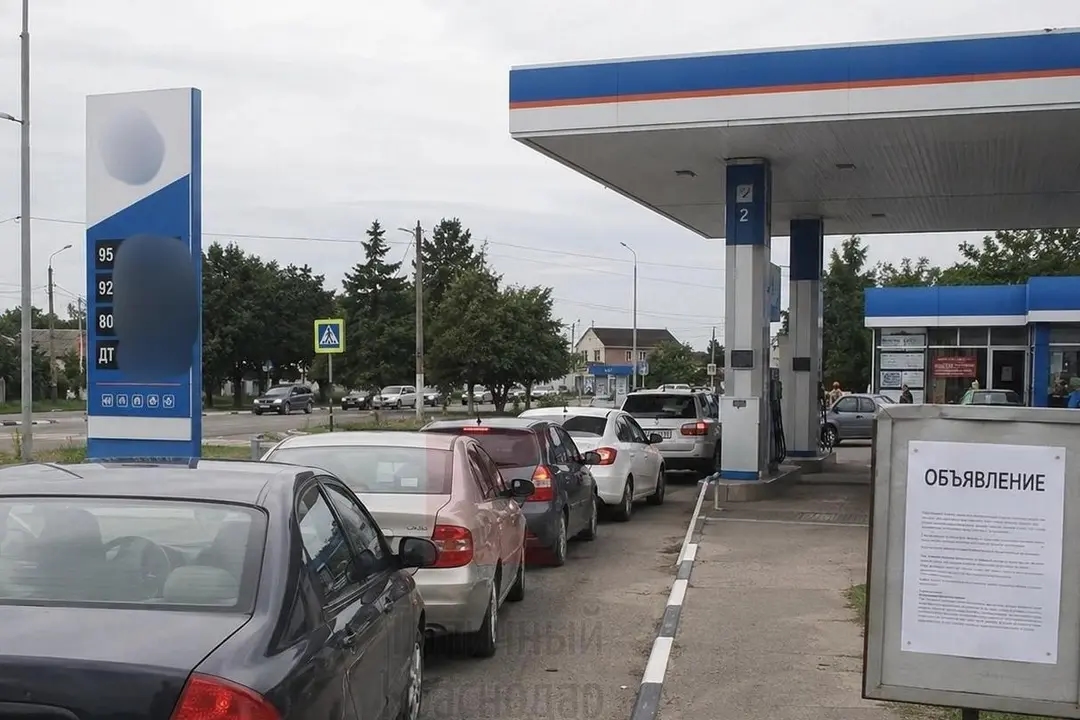
Residents of Russia’s southern Krasnodar Region have begun reporting gasoline shortages at filling stations, with local media and Telegram channels saying problems with availability have been observed in the cities of Krasnodar and Anapa, and along highways leading toward the Black Sea coast. Local social media pages reported that some gas stations had run out of gasoline, while long lines formed at others.
Witnesses said drivers were filling both their cars and fuel canisters as a precation.
Residents said gasoline was especially difficult to find on the outskirts of Krasnodar and along the road toward Anapa and the village of Blagoveshchenskaya.
A local resident describing the shortages in a video on social media
Krasnodar | Teletype («Краснодар | Телетайп») / Telegram
Some drivers were forced to buy AI-92 grade gasoline and then search for the higher-grade AI-100. Local residents suggested the situation may also have been affected by the fuel crisis in annexed Crimea, as residents of the peninsula may have begun traveling to neighboring regions to refuel where gasoline is still freely available.
A local resident in Anapa filming a line of cars waiting for gas at a Lukoil filling station on Lenina Street, 180
Typical Anapa («Типичная Анапа») / Telegram
Krasnodar Region governor Veniamin Kondratyev agreed with that version of events, claiming there was no gasoline shortage in his region. According to Kondratyev, the reports of disruptions appeared amid a “difficult situation” in neighboring regions, with local residents deciding to stock up on fuel as a precautionary measure, apparently creating an “artificial rush.”
Kondratyev added that temporary supply problems were mainly observed at small private filling stations, while gasoline remained available at most large chain stations. Suppliers were already “optimizing logistics” to avoid long-term disruptions, he said.
The Krasnodar Region emergency response headquarters also said fuel was available at gas stations run by major chains, and that disruptions at private stations occurred as a result of the fact that they buy gasoline in small wholesale batches and do not have long-term contracts.
In early June, restrictions on the sale of gasoline began to be rolled out in several Russian regions, as well as in annexed Crimea and the occupied Luhansk Region of Ukraine. Limits were also introduced in Moscow and the Moscow Region, St. Petersburg, and the Belgorod and Kursk regions. In some cases, gasoline sales were capped — at between 20 an 60 liters per customer — while some filling stations also restricted sales into canisters.
The sharpest disruptions were reported in annexed Crimea, where AI-95 gasoline sales were capped at 20 liters per customer per day. The shortage fueled a “shadow” market, with resellers charging up to 250 rubles per liter, well above the standard retail price of around 70 rubles. Reports later emerged of shortages of staple goods including sugar, grains, flour, pasta, and vegetable oil. An overnight attack on June 8 against the locomotive of a Moscow-Simferopol passenger train also disrupted scheduled rail service.