
The French mathematical journal Revue de la filière mathématiques (RMS) has published a scientific paper by imprisoned Russian mathematician and anarchist Azat Miftakhov, who worked out the problem while being held in a prison in Dimitrovgrad. His article, “La conjecture de Chui dans un cadre hilbertien” (“Chui’s conjecture in a Hilbert space setting”) appeared in the journal’s June-August 2026 issue and was the first original research article in the edition. Miftakhov’s support group reported the publication earlier today.

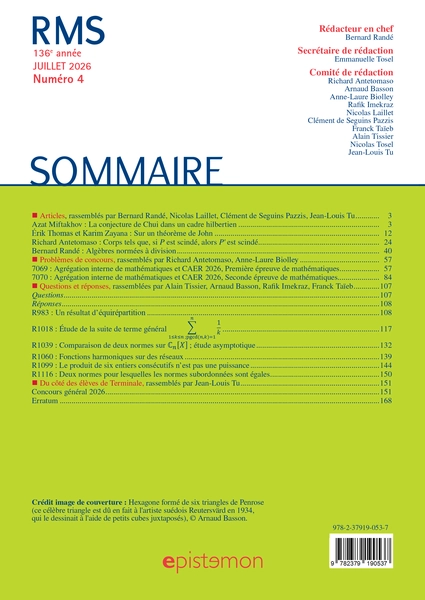
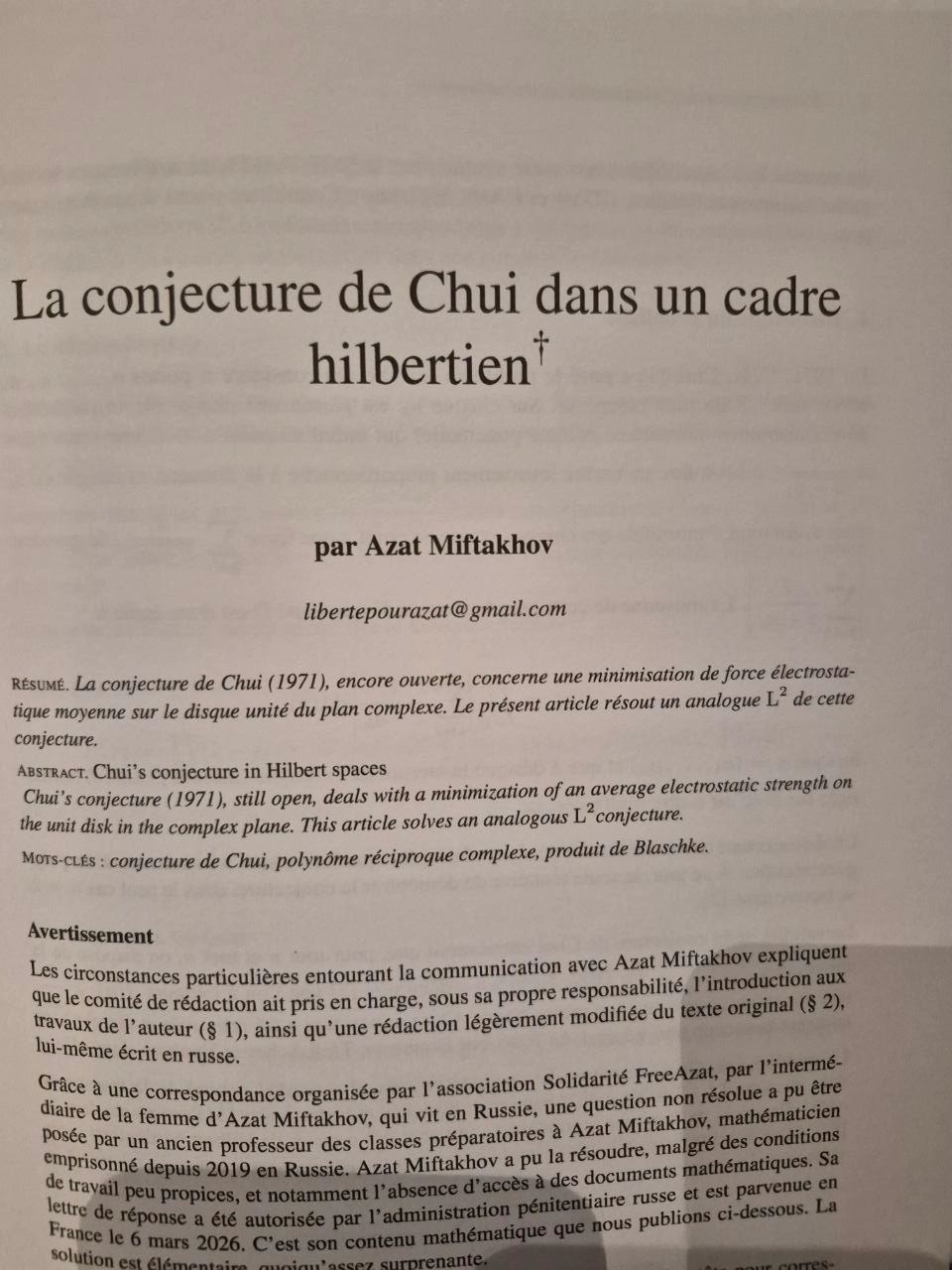

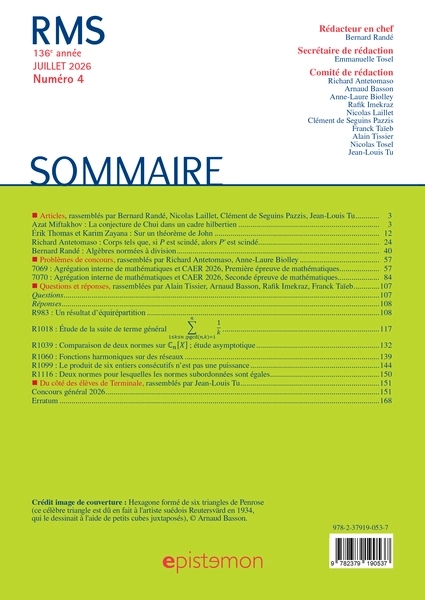
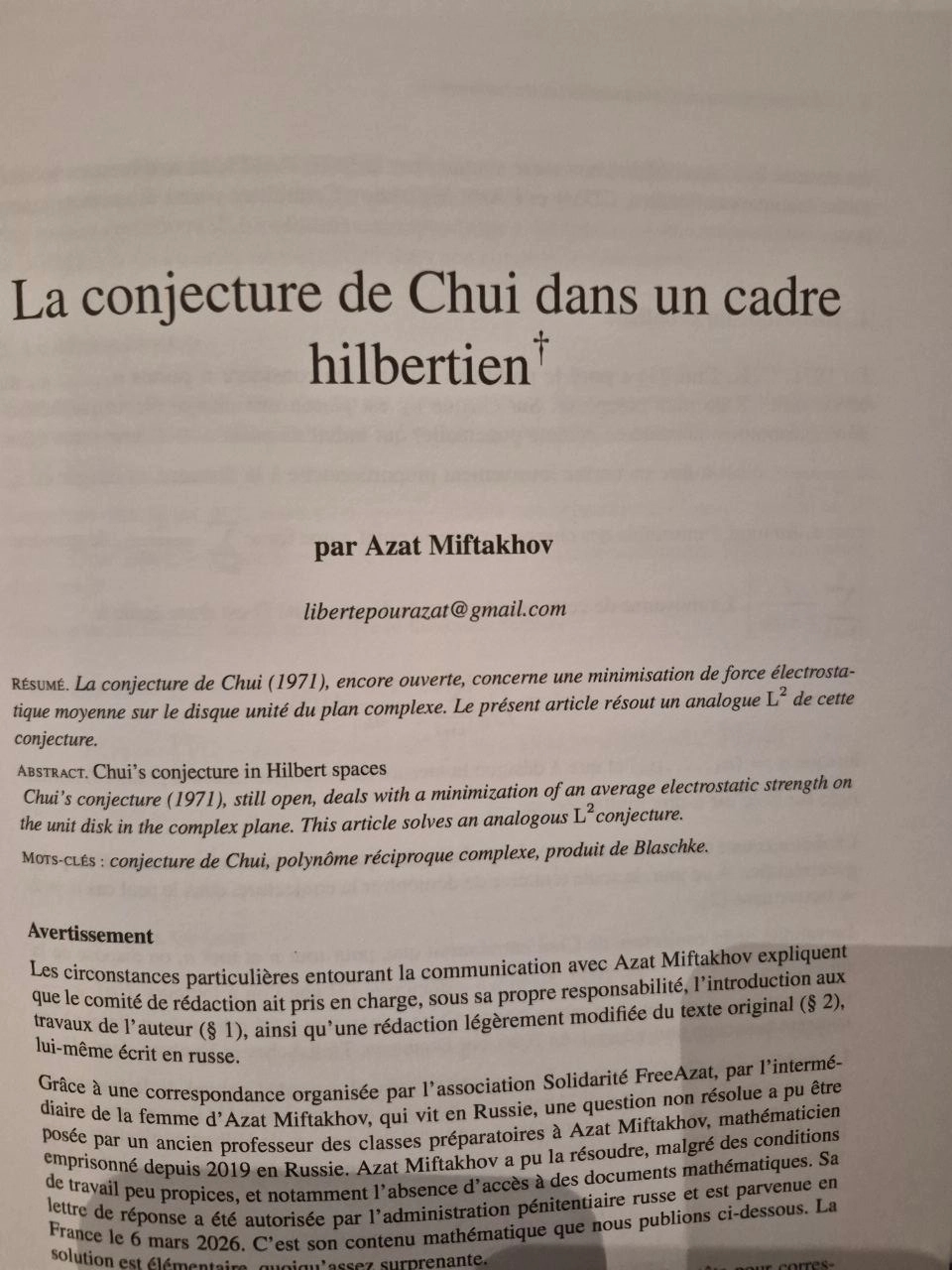
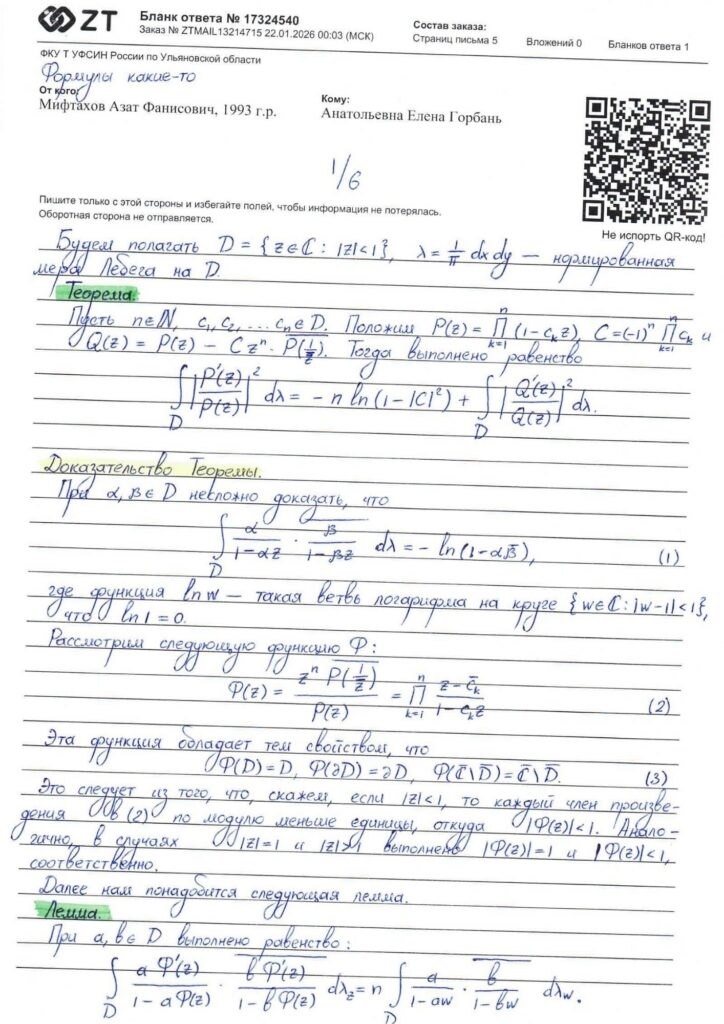
The paper was facilitated by French mathematician Bernard Randé, a member of Solidarité FreeAzat. The association said Randé decided to support Miftakhov as a fellow mathematician and sent him a problem related to Chui’s conjecture, a modified version of an unsolved mathematical problem. Miftakhov, who was in custody, worked on it for about four months under conditions in which he had no access to the internet, no scientific library, and almost no opportunity to discuss the work with other mathematicians.
After Miftakhov solved the problem, Randé then helped prepare the result for publication in French. Solidarité FreeAzat had earlier said the article was expected to appear in RMS in early August. In July, the University of Pisa also formally invited Miftakhov to present the result at a scientific seminar in April 2027.
Miftakhov, a graduate student in the mathematics and mechanics department at Moscow State University, was first arrested in 2019. In January 2021, he was sentenced to six years in a general-regime penal colony in a case over an attack on a United Russia office. Investigators alleged that Miftakhov and other anarchists broke a window and threw a smoke bomb inside. Miftakhov pleaded not guilty.
He was released in September 2023, but was detained again immediately outside the penal colony — this time in a case of “justifying terrorism.” The charge was based on an alleged conversation between Miftakhov and a fellow inmate. That prisoner, who later became the prosecution’s main witness, was subsequently killed in the war in Ukraine.
In the second case, Miftakhov was sentenced to four years in custody, with the first two and a half years to be served in prison and the remainder in a high-security penal colony. It was while he was held in the prison in Dimitrovgrad that he solved the mathematical problem Randé had proposed.
After completing the prison portion of his sentence, Miftakhov was transferred to IK-18 Polar Owl, a penal colony in the settlement of Kharp in the Yamalo-Nenets Autonomous District. Notably, Polar Owl is located down the road from IK-3 Polar Wolf, where the late opposition politician and anti-corruption activist Alexei Navalny was murdered with a deadly frog-derived toxin in February 2024.
In May, Miftakhov reported that shortly after his arrival at Polar Owl, prison staff and two inmates tortured him for several hours. He said they beat the soles of his feet with a wooden mallet, threatened him with sexualized violence, threatened to dunk him in a sewage manhole, blocked his breathing, and tortured him with electric shocks.
Russia’s Investigative Committee initially refused to open a criminal case into the matter, saying the torture allegations had not been confirmed. Then, on July 15, a court in Labytnangi ruled that the investigator’s inaction was unlawful and ordered the violations to be corrected.