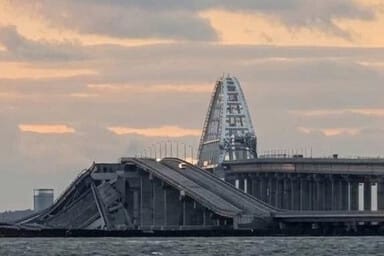
Ukraine’s military leadership had the technical information needed to successfully strike the Kerch Strait Bridge as early as summer 2025, an informed source told The Insider, but the operation had to be postponed due to a lack of necessary strike capabilities. As the source explained:
“The idea was to weaken the ties and cable-supported section of the arch and then give nature some time to do its work — the waves and the wind — before slightly lifting the structure with a blast wave. Let the laws of physics do the heavy lifting.
To do that, it was necessary to hit specific small points where force could be applied most effectively, and to do so in a particular sequence. What was missing were ultra-precision strike capabilities — a communications link, a stable video feed, telemetry, and control — as well as sufficient operator experience. It is extremely difficult to hit a target the size of a washing machine with a missile weighing hundreds of kilograms and traveling at 400 to 800 kilometers per hour, especially while air defenses and electronic warfare systems are operating and amid Starshield outages.”
Weak points
The Insider reviewed an analytical briefing outlining the results of an examination of the bridge’s technical documentation, along with photographs. Among the structure’s most vulnerable elements, the report identified the steel suspension cables supporting the main span of the road bridge.
The briefing examined several possible ways to disable the bridge.
- A cyberattack on the bridge’s lighting control systems while large Russian vessels were passing underneath. The idea was that, in darkness, the vessels could crash into the bridge supports and damage them. The report also proposed hacking the automated traffic-management system to create traffic jams and crashes on the bridge that could damage structural elements. The authors described this as the easiest option to carry out but noted that it would not necessarily cause serious damage.
- Destroying the bridge’s power infrastructure. This option was also considered relatively simple but not particularly effective.
- A missile strike using precision weapons in sufficient numbers to hit several key points on the bridge simultaneously. The targets identified were the support areas, the key upper joint of the arch, and the tie members of the bridge span.
- An attack using unmanned aerial vehicles (UAVs).
- An attack using unmanned surface or underwater vessels.
- Detonating a vehicle on the bridge, as was previously done in October 2022.
Nature of the damage and consequences
At The Insider’s request, Konstantinos Tsavdaridis, Professor and Chair of Structural Engineering at City St George’s, University of London, reviewed publicly available information about the attacks on the bridge and provided an expert assessment of the damage:
“The failure appears to have happened in two stages. After the strike on Nov. 16, the road arch was visibly tilted sideways, which indicates that its bearings or lateral restraints had already been compromised. The second strike then brought it down. This sequence matters for everything that follows.
The navigation span is a tied arch: the arch and the deck balance each other's forces, so its collapse should not, in itself, pull down the adjacent approach spans. The vulnerable points are the two transition piers where the span sat, together with their bearings and expansion joints. The road and railway are separate structures. The railway is not affected through shared load, but it was exposed to the same attacks.
[The piers] is where I would be most cautious. The span stood tilted under its own weight for about a day, and then more than 5,000 tonnes slid or dropped off the pier tops. Damage to the pier heads and bearing seats should be the working assumption, and undamaged foundations should not be assumed. Debris lying against the pier bases also increases the risk of scour. Only a survey of pier position and inclination, together with an underwater inspection, can show whether the piers can be reused, need local repair, or need substantial reconstruction.
A complete new arch should be assumed. Steelwork that has twisted, fallen, and been submerged in seawater cannot realistically be certified for reuse (if undamaged, it could potentially be reused). Building a replacement is technically feasible. The original was assembled on shore in 2017, floated out on pontoons, and lifted into place. The difference now is security: a float-in operation of a structure this size takes days and would be highly exposed to attack.
Under normal conditions, a permanent replacement of the road span would in my view take on the order of 12 to 24 months, depending above all on the condition of the piers. Under the present threat conditions, I would not put an upper limit on it. A temporary low-level crossing could restore road traffic sooner, but it would block the navigation channel, so restoring the road and restoring shipping are competing objectives. A restricted passage could be opened once a corridor has been cut through the wreckage, well before all the steel is removed.
Permanent restoration of the road span is a matter of many months at the very least, and under current conditions it is not possible to put a credible date on it.”
Russia’s Transport Ministry said on Nov. 17 that rail traffic across the Kerch Bridge had resumed on one track, while repair work continued on the second. Professor Tsavdaridis said that this indicated the railway section of the bridge had also been damaged and was “in restricted operation”:
“A damaged structure can be operated safely with restrictions. The longer-term concern is the fatigue performance of any damaged hangers or connections under repeated heavy freight loading. I would describe the rail bridge as standing and in restricted operation, not as intact.”
Tsavdaridis stressed: “Most of the figures now circulating about the Crimean Bridge come from Telegram channels and OSINT reconstructions, not from inspection. Until the structure has been surveyed, any firm statement about reuse, repair time, or reopening dates is speculation, whoever makes it.”
Retired general and military analyst Mick Ryan told The Insider that the damage to the Kerch Bridge would complicate Russian military logistics:
“It cuts road traffic to Crimea, although there are alternatives through southern Ukraine. But these have been subject to interdiction by Ukraine's mid-range strike campaign in recent months, as have Russian ferries and landing ships. So Russia has no land supply route to Crimea not able to be held at risk by Ukraine.
Dropping the road span into the waterway below will also restrict shipping into and out of the Sea of Azov, impacting Russian exports.”
Three attacks
The bridge, which connects Russia’s Taman Peninsula in the Krasnodar Region with the Kerch Peninsula in Russian-occupied Crimea, was partially destroyed after two attacks on Nov. 16 and 17.
On Nov. 17, Ukrainian President Volodymyr Zelensky said several types of drones had been used in the operation, with Neptune and Flamingo missiles and Ruta missile-drones carrying out the final strike. The missiles struck the road deck, while the drones targeted the railway tracks.
“This is the result of the seventh stage of an operation that has been underway for several weeks, and which was developed and coordinated by the Security Service together with the General Staff of the Armed Forces of Ukraine. Our soldiers systematically destroyed air defense systems, radars, electronic warfare equipment, and other designated targets along the way to the final objective,” Zelensky said.
Overnight into Nov. 19, Ukraine attacked the Crimean Bridge again for the third time in a week. Russia’s Transport Ministry said rail traffic across the bridge had been halted following the strikes.