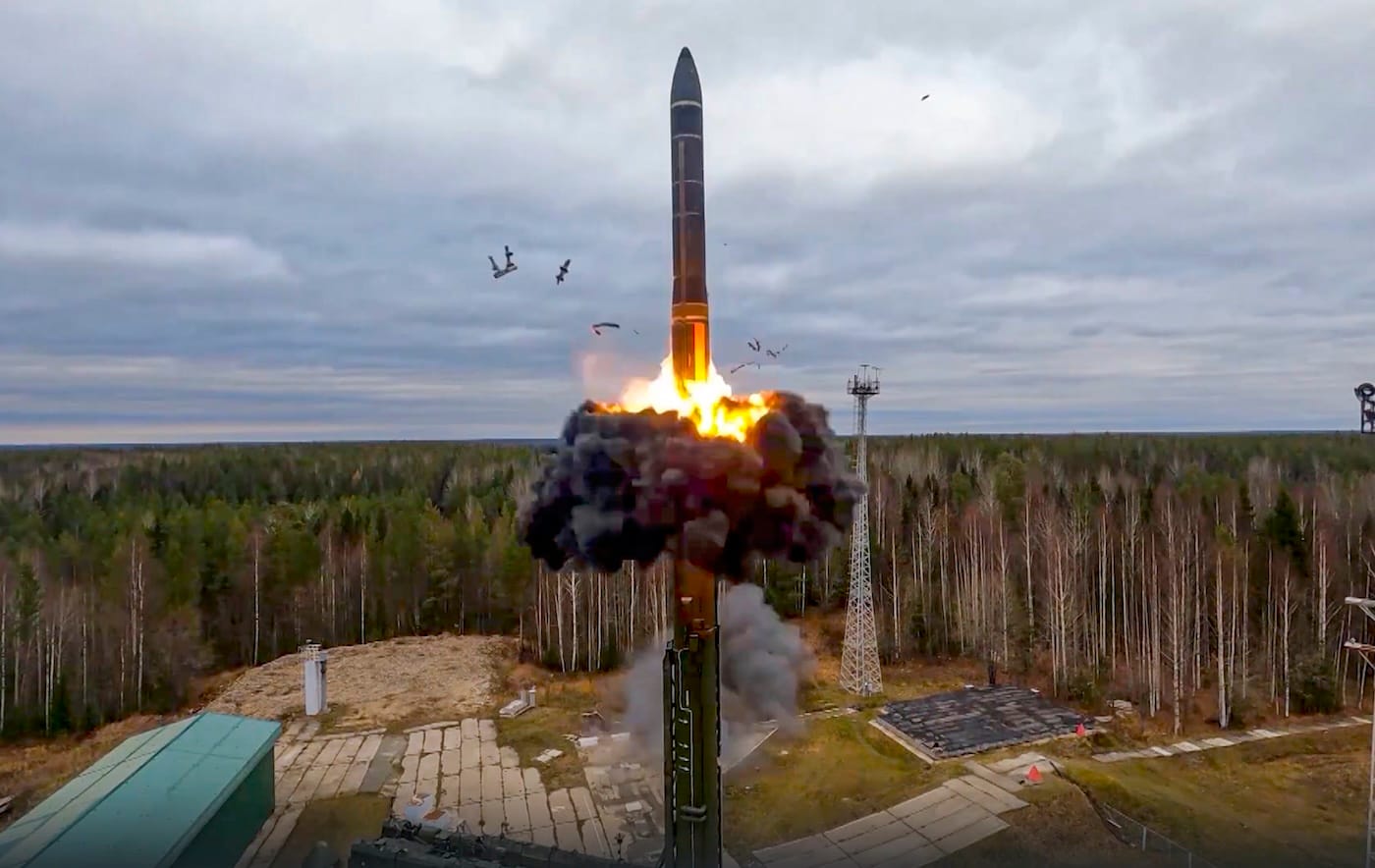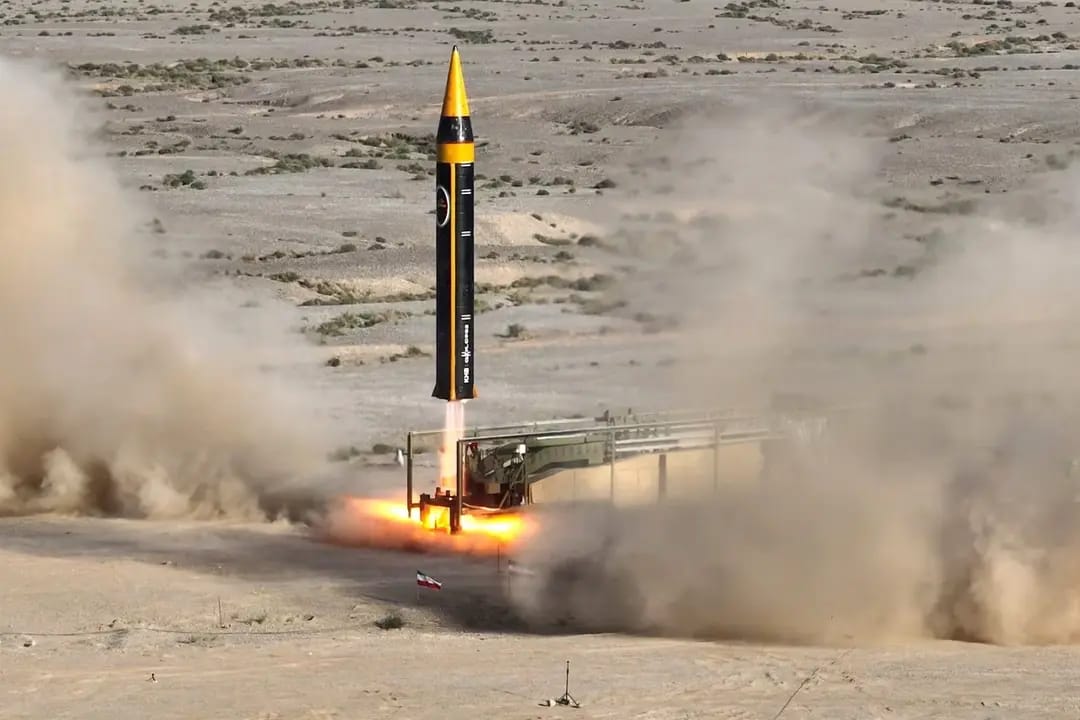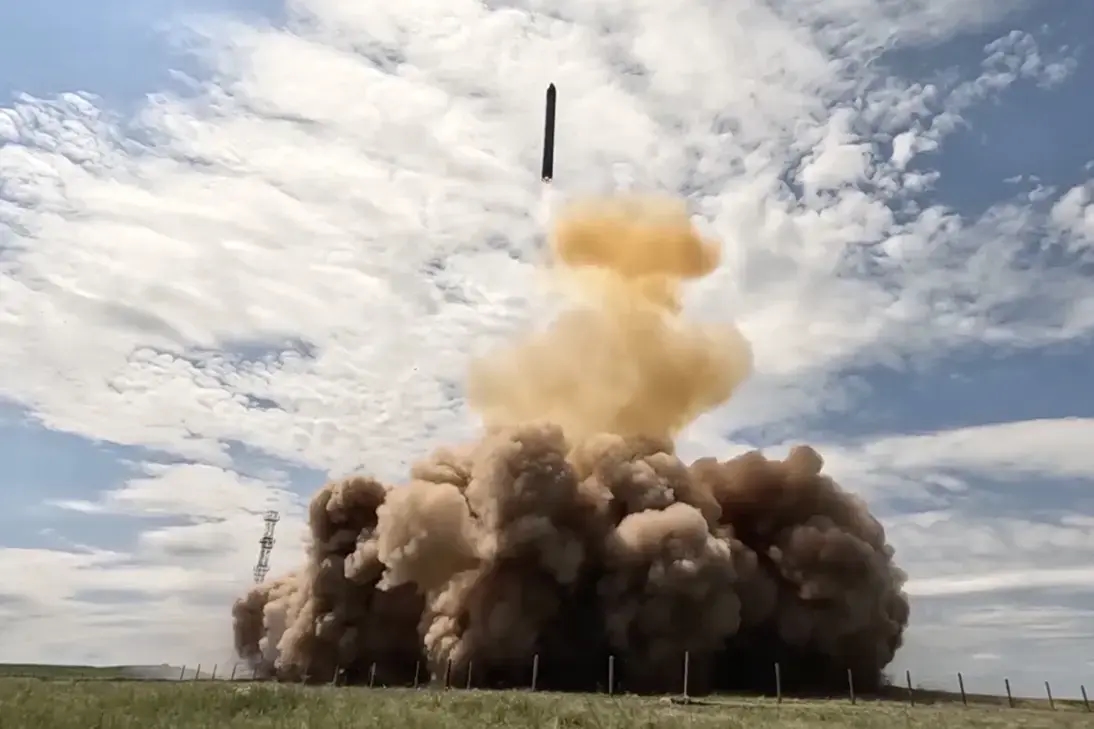

In May, Vladimir Putin announced that Russia had successfully tested its new Sarmat intercontinental ballistic missile, which he said can travel up to 35,000 kilometers and bypass U.S. missile defenses by using unconventional flight paths via Antarctica. Development of the Sarmat, which has lasted for more than a decade, has been marked by numerous difficulties, including a 2024 test explosion that caused significant damage at the Plesetsk military spaceport. Although the new system does pose a serious threat to the United States, it is neither a technological nor a strategic breakthrough. Instead, its deployment would herald a return to the logic of the Cold War-era arms race, writes Sam Lair, a researcher at the James Martin Center for Nonproliferation Studies.
In mid-May, the Russian Strategic Rocket Forces announced that they had conducted a successful test of the RS-28 Sarmat ICBM, the first since 2019. Sarmat is slated to be the successor to the current SS-18/R-36M2 Voevoda, a heavy liquid propellant ICBM capable of carrying up to 10 warheads. In the wake of the recent accomplishment, Vladimir Putin took to state TV to announce that the missile would be ready for “combat duty” by the end of the year, adding that it has a range of 35,000 km. While this is one of many such pronouncements from Putin regarding Sarmat’s imminence, the test does represent the first positive signs for a program that has had a troubled development history.
Reports that the missile which would eventually become Sarmat was under development began in 2011. A former chief of staff of the Strategic Rocket Forces gave a quote saying that development of a new, heavy liquid propellant missile was underway and that it was being developed by the Makeyev Design Bureau. The choice of Makayev was curious, as the bureau was focused on submarine-launched ballistic missiles at the time.
Reports that the missile which would eventually become Sarmat was under development began 15 years ago — in 2011
However, given that the Yangel Design Bureau that had had made the SS-18 series during the Soviet era was now located in independent Ukraine, it was no longer an option. Meanwhile, NPOmash, the original proponent of the new missile, had too many other projects.
Thus Makayev got the contract. The missile was originally supposed to be deployed by 2020. Clearly, that deadline was not met.
The choice to have Makayev lead the project may have contributed to Sarmat’s problems with development. Makayev had never designed a missile that large, nor had they designed a land-based missile since the time of the Cold War-era Scud-B. There were several delays in the ejection tests of the new missile, but in 2017 a set of successful pop up tests were conducted and in 2018 the cold launch ejection system was validated. The first flight test of the missile did not occur until 2022 — a full two years after the missile was supposed to have been deployed. In short, it is clear that a program is not going well when a major fire breaks out at the production plant and the Minister of Defense says he “will demand weekly reports on the progress with development.”
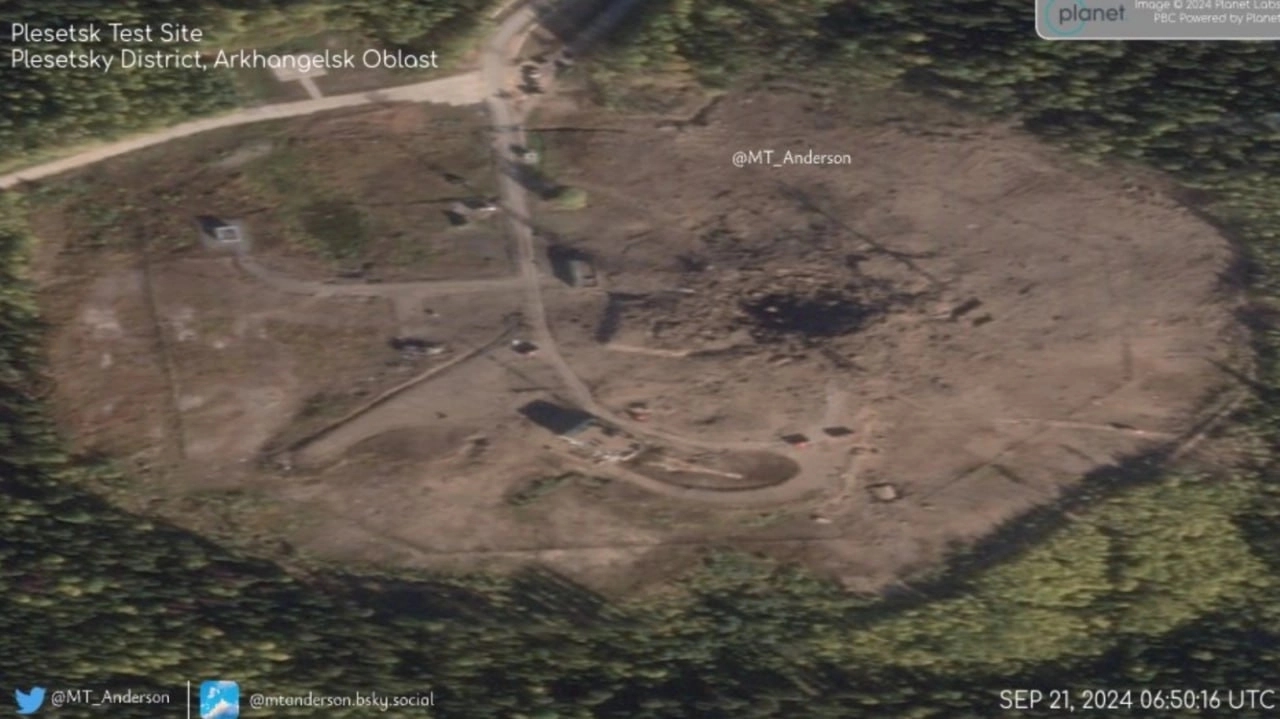
Despite a successful first flight test, problems continued to plague the Sarmat program. The second flight test in 2023 merely failed, while the third flight test in 2024 failed spectacularly when the missile exploded after ejection from the silo, causing serious damage to the test infrastructure at Plessetsk and leaving a large crater. The destruction of the silo itself indicates the missile was ejected properly, but its engine failed to ignite, causing it to fall back into the silo, whereupon the propellant detonated. This is reminiscent of the first R-36M2 Voevoda test launch in 1986, which failed in the exact same way when the main engine failed to start.
Considering this rocky development cycle, Makayev and the Strategic Rocket Forces must have let out a collective sigh of relief after the reportedly successful test in mid-May. But why persist with such a troubled program? There are three clear reasons — one organizational and two strategic.
Competition defines strategy
As I alluded to earlier, the organizational politics of Russian missile procurement can be nasty. Indeed, during the late 1960s competition within the defense industry was so intense that it was dubbed the “little civil war.” While the situation is likely not as severe now as it was then, internal competition and the bureaucratic power of the liquid propellant missile design bureaus provide some of the impetus for these kinds of missile systems.
As mentioned earlier, it seems NPOmash was the biggest advocate within the defense industry for a new, large liquid propellant system, but it got edged out by Makayev. Of course, the plan was opposed by the leadership of the Moscow Institute of Thermal Technology, which produces solid propellant ICBMs that compete with the liquids, underscoring the fraught nature of the Russian missile industry. The NPOmash leadership argued against creating a dependence on solid-fuelled systems and gestured towards Russia’s traditional strength in liquid-propellant missiles. What becomes clear looking at the drama is that these are large, powerful firms with competing interests and different people who are dependent on them. To some extent, elements of the Russian modernization program reflect their individual preferences.
Internal competition and the bureaucratic power of Russia’s liquid propellant missile design bureaus provide some of the impetus for these kinds of missile systems
However, it would be incorrect to solely chalk Sarmat up to the prerogatives of the Russian missile industry, powerful as its players may be. Sarmat also fills important roles in the Russian strategic nuclear force. The first is that it helps with target coverage. Given its massive size, Sarmat, like its predecessor the SS-18 Satan, can deliver lots of warheads. Previously, the Voevoda was thought to carry only five warheads in order to help keep the Russians compliant with New START; however, now that the treaty has expired, Russia could return to the R-36M2’s regular loading of ten warheads, in addition to added missile defense countermeasures.
The independent targeting of the warheads makes it quite powerful as a counterforce weapon, as each SS-18 could hit 10 enemy missiles. Given the resource constraints faced both by the Soviets of old and by the Russians of today, large MIRVed missiles are an efficient way to cover large target sets, as they have since the SS-9/R-36 variants came online in the early 1970s.
New old threats
Beyond covering target sets, Sarmat is part of Russia’s effort to break down U.S. homeland missile defenses. Ever since Washington left the ABM treaty in 2002, the Russians have had to face the problem of defeating a slowly expanding American homeland defense network. When the Russians decided to pursue Sarmat in the early 2010s, that defense consisted of 30 Ground-Based Interceptors in Alaska as part of the Ground-Based Midcourse Defense system. However, the missile defense problem for the Russians has only grown since then. By 2017 the GMD system had expanded to 40 GBIs in Alaska and four in California, and those interceptors will soon be replaced with the Next Generation Interceptor, each of which will carry multiple kill vehicles in order to target several warheads. This more robust GMD system could be complemented by Aegis missile defense systems or even space-based interceptors as part of Donald Trump’s Golden Dome for America program.
Sarmat is often described as “Son of Satan,” as Satan was the name the U.S. Intelligence Community assigned to the SS-18. However, Sarmat may bear more similarities to its grandfather, the SS-9, than to its immediate predecessor. The role Sarmat plays in defeating U.S. defenses is twofold, and both resemble the way the SS-9 was used in the late 1960s and early 1970s.
First, Sarmat can oversaturate defenses, and some current (albeit uncertain) reports indicate Sarmat will have a max warhead loading similar to that of the R-36M2, which carries 10 reentry vehicles. Current shot doctrine for the GMD system likely assigns at least two — and probably four — interceptors to each incoming warhead. This doubling up of interceptors means it would take only one or two fully loaded Sarmats to consume all of America’s dedicated midcourse interceptors.
It would take only one or two fully loaded Sarmats to consume all of America’s dedicated midcourse interceptors
Moreover, this attrition does not account for the various missile defense countermeasures the heavy ICBM might carry, such as chaff clouds, various simulation and antisimulation decoys, and jammers, which may cause each Sarmat to demand even more interceptors. While this resembles how the SS-18 would have defeated U.S. defenses, it also bears similarities to the innovations of the SS-9, the first Soviet missile to carry multiple reentry vehicles. And as that system’s accuracy and technological foundation improved, independently targetable reentry vehicles became a feature.
Second, Sarmat can go around obstacles. In 2018, Putin announced a panoply of exotic systems — nuclear-armed nuclear-powered cruise missile, a nuclear torpedo, and hypersonic glide vehicles, in addition to Sarmat — that were designed to defeat U.S. missile defenses in diverse ways. In his comments after the most recent test, Putin stated that Sarmat had a range of 35,000 km and would be able to target the U.S. from the south, rather than going over the North Pole like most ICBMs. Given the fact that the majority of U.S. early warning radars and missile defenses are oriented northward, a southern shot would circumvent America’s missile defense architecture.
The southern shot capability may seem like a novel development — one that the SS-18 clearly lacked — but it is actually a feature taken out of the SS-9’s playbook. In the mid-1960s, as the U.S. began getting serious about missile defenses, the Soviets sought a response. Their solution was a Fractional Orbital Bombardment System added to some variants of the SS-9, which became the SS-9 Mod 3 and the R-36O. Instead of following a ballistic trajectory to its target, the FOBS would place its reentry vehicle into orbit, like a satellite. Once it arrived over the target, a reentry burn would deorbit the reentry vehicle.
The Soviet FOBS could attack the U.S. from the south, like the Sarmat, in order to avoid American radars. Indeed, some reports indicate that Sarmat may be armed with a FOBS, just like its progenitor. FOBS had been banned by the SALT II agreement signed by President Carter and General Secretary Brezhnev in 1979. That agreement never went into force, as Carter withdrew it from consideration by the Senate after the Soviet invasion of Afghanistan; however, both parties largely adhered to its limits until 1986.
Back into the arms race
Will Sarmat be ready for “combat duty” by the end of this year as Putin indicated? Given the track record of the program, my guess is probably not. While construction is underway at the 62nd Missile Division at Uzhur to upgrade Voevoda silos for Sarmat, they will likely only be filled once the missile is actually ready for deployment, which may demand several additional flight tests. Whenever it is finally deployed, be it this year, next year, or a later date, Sarmat will embody a retread of Soviet thinking rather than some profound breakthrough or innovation. It reflects an industrial preference for large, liquid-propellant missiles. It draws upon tried and true methods for defeating the resurgent problem of American missile defenses. It is even suffering from the same problems in testing that plagued its predecessors.
Whenever it is finally deployed, be it this year, next year, or a later date, Sarmat will embody a retread of Soviet thinking rather than some profound breakthrough or innovation
While it would be unwise not to take it seriously as a threat to the U.S., it would also be incorrect to characterize it as a novel one. If Sarmat is symbolic of anything, it is the return of some of the most dangerous dynamics of the Cold War arms race — organizational interests synergizing with the arms competition between offensive and defensive systems to produce precarity in the strategic balance. One can only hope we are prudent enough today to temper this competition sufficiently to avoid calamity, as the U.S. and the Soviet Union were able to do back then.