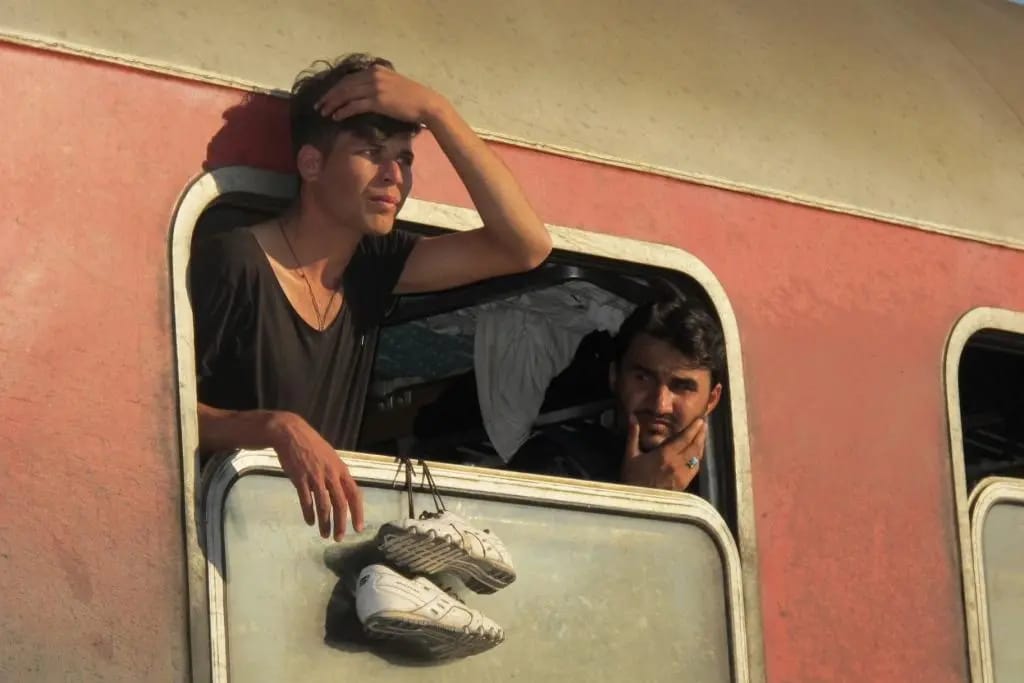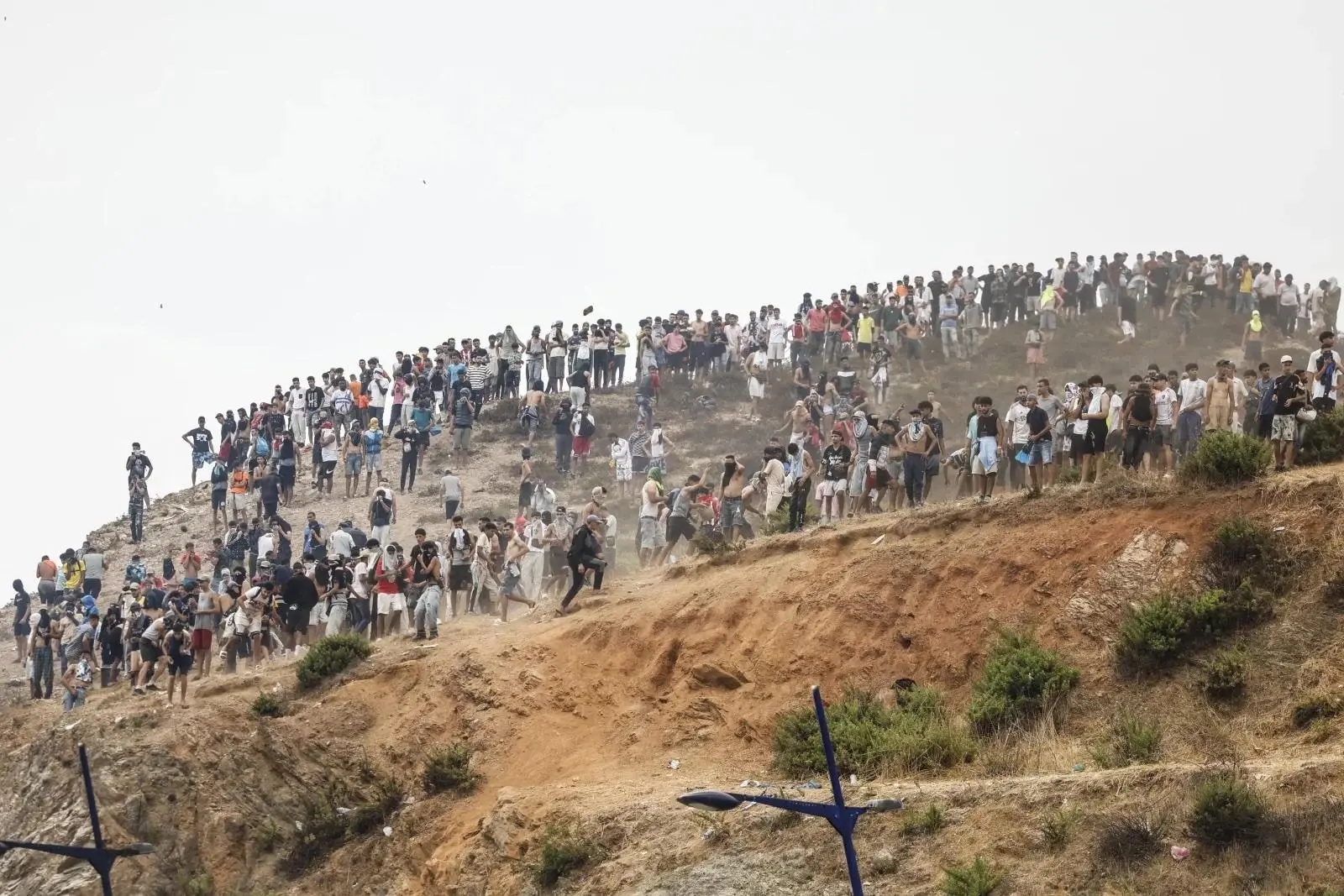

Following the migrant crisis in Ceuta, when tens of thousands of Moroccans entered the Spanish enclave only to disappear just as suddenly, conspiracy theories about the secret designs of Morocco, Spain, Russia, and even Israel spread across the global information space. European far-right activists and teams of Kremlin bots played an active role in this political panic. Maxim Matusevich, an Africa expert and professor at Seton Hall University in New Jersey, explains how rumors spread on social media, combined with real migration problems, triggered a crisis that immediately became fodder for propagandists in both Europe and Russia.
A fleeting invasion
There is something strange about Ceuta. From the Moroccan shore, the Spanish enclave looks tantalizingly close – almost close enough to reach out and touch, and certainly close enough to swim to. A strait just a few miles wide separates Africa from a part of Spain that, geographically speaking, lies on another continent.
Yet geography has never played a decisive role in this matter. Ceuta is a city of about 83,000 people, home to one of the European Union’s most vulnerable borders. It is Spanish territory, but Morocco does not recognize it as such. For generations, Ceuta’s residents have understood that the nearby border is at once a line on a map, a geopolitical fault line and a part of everyday life.
In late July 2026, this unusual geographic situation provided the backdrop for one of Europe’s largest migration episodes in recent years. On July 30 and 31, thousands of people headed toward Ceuta from Morocco. Spanish authorities estimated that tens of thousands crossed or attempted to cross the border during the mass breach.
According to one estimate by the Interior Ministry, around 49,000 people crossed it in a single day. Later estimates from the ministry put the figure at approximately 72,000. Spanish security forces struggled to contain the flow, and the military had to be brought in to assist. The migrant reception system was overwhelmed, and tensions in Ceuta reached a peak.
More than 80 migrants were ultimately reported to have died, many of them drowning or being killed in the crush among those trying to enter the enclave. Yet the true nature of what had happened became clear only afterward. Those who entered Ceuta did not stay there. Soon, the overwhelming majority of them – around 70,000 people – returned to Morocco.
Thus, the “invasion,” as some Spanish politicians and international commentators called it, turned out to be remarkably short-lived. The political consequences of the events, however, continue to be felt across Europe.
How the disinformation emerged
The immediate cause of the mass breach, at first glance, was simple: people believed the Spanish border was open. The rumor spread via Instagram, TikTok, Facebook and private messaging networks. Videos showed people who had reached Ceuta, while other posts described swimming routes, Spanish and Moroccan patrol locations, and purported changes to Spain’s migration policy.
Apparently, some migrants interpreted a recent ruling by Spain’s Supreme Court as meaning that people arriving by sea could not simply be returned to Morocco. In reality, the legal situation was considerably more complex. The Supreme Court ruled on how the procedure under Spanish law for refusing entry at the border should apply to people arriving by sea. The court limited the circumstances in which migrants could be immediately refused entry, but this did not mean that the Ceuta border was open or grant an automatic right to enter Spain or other Schengen countries.
Online, however, this subtle legal distinction was reduced to a simple claim: Spain had opened its doors. That was enough to send thousands of people, predominantly young men, into the Mediterranean from the Moroccan side of the border.
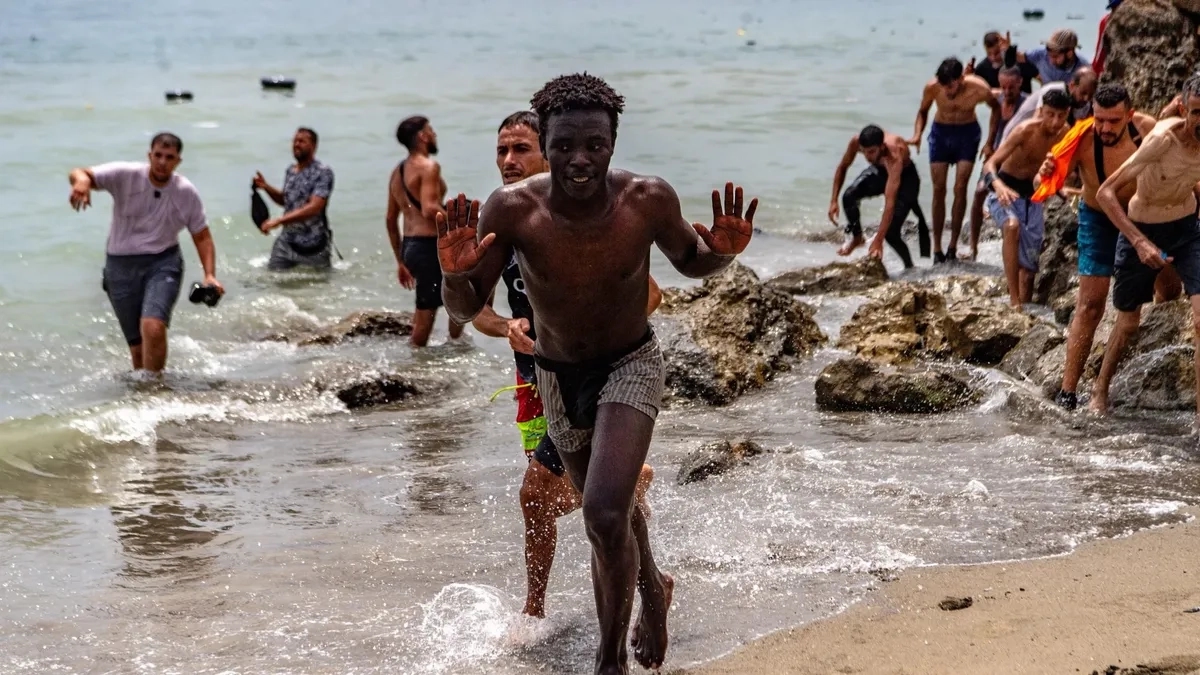
Le Monde’s investigation found no convincing evidence that a centralized disinformation campaign was behind the original rumor. Instead, the newspaper described something more chaotic and, in some ways, more disturbing – a “snowball effect” in which successful attempts to cross the border generated new videos, the videos shaped expectations, and those expectations encouraged ever more people to attempt the crossing.
WhatsApp and other closed networks made it virtually impossible to establish the rumor’s original source. This is important because the conventional understanding of disinformation assumes that there is an author. Someone lies, someone else believes the lie, and society faces the consequences. But the story of Ceuta points to a different model: a rumor can take on a life of its own.
The technology that made this possible is new, but the phenomenon itself is far from new. Migrants have always depended on information from those who set out before them. In the past, advice and directions might come from a cousin in Spain, a friend in Morocco, or a fellow traveler encountered along the way.
In 2026, a smartphone has become the source of such information. A video showing someone successfully swimming toward Ceuta does more than provide information – it can change a person’s perception of the risks involved. In other words, it may have created the impression that conditions at the border had changed before they actually had. And that was enough to set people on their way.
Videos of people swimming created the impression that border-crossing conditions had changed before they actually did
The extraordinary scale of this migration flow should not obscure the main point. For the crisis to emerge, it was not necessary for tens of thousands of people to independently reach the same conclusion. Social media created a mechanism in which one person’s decision became evidence for another. The more people set out, the more plausible the appearance became that something had changed. And once thousands were on their way, the rumor began to confirm itself.
A border with a long historical memory
For Spaniards, suspicions that Morocco may have played a role in the Ceuta crisis did not arise out of nowhere. The two countries share a long and complicated history.
Ceuta’s special status dates back many centuries. In 1415, the city was conquered by the Portuguese. In 1580, it passed to the Spanish Crown and has remained Spanish ever since.
Morocco, however, has never recognized Spain’s sovereignty over Ceuta and Melilla, another Spanish city and port on Africa’s Mediterranean coast. In this sense, the two cities are remnants of an imperial geography that survived decolonization.
The question of sovereignty, therefore, rarely recedes into the background, particularly at a time when the history of European colonialism is once again receiving close scrutiny around the world. Mass migration has made the issue even more salient.
The precedent most often cited is May 2021, when around 8,000 migrants entered Ceuta over several days amid a serious diplomatic crisis between Spain and Morocco. The immediate cause of the crisis was Spain’s decision to allow Brahim Ghali, leader of the Polisario Front of Western Sahara, to receive medical treatment in Spain.
Morocco viewed the decision as a serious diplomatic insult because it does not recognize the Polisario Front’s authority over Western Sahara, which it considers part of Morocco. The subsequent loosening of border controls was widely seen in Spain as a form of pressure by Rabat. The episode established an important precedent in the Spanish political consciousness: if it chooses to do so, Morocco can use migration as a tool of pressure. The events of 2026 inevitably brought that memory back to the fore.
There were grounds for suspicion. The July breach coincided with Morocco’s Throne Day celebrations, which reportedly limited the ability of the country’s security forces to respond to the events. Spanish officials also took into account the broader context of tensions over Western Sahara, Morocco’s rivalry with Algeria, and Madrid’s changing relationship with Rabat.
Some Spanish analysts went further. Carlos Echeverría Jesús, director of the Observatory of Ceuta and Melilla, said in Le Monde that the crisis should be viewed against the backdrop of Morocco’s broader territorial ambitions. In his view, the 2021 crisis, the dispute over Ceuta and Melilla, and other instances of pressure from Morocco form a broader pattern of “hybrid warfare” intended to demonstrate Morocco’s ability to destabilize Spain’s security environment.
This argument cannot simply be dismissed. However, there is currently no evidence that Morocco organized the influx of migrants in July 2026. Rabat does have considerable capacity to influence migration flows toward Ceuta. The authorities patrol the Moroccan side of the border and have an extensive security apparatus at their disposal.
Moreover, Morocco has demonstrated in the past that migration pressure can become intertwined with diplomatic disputes. But there is still no convincing evidence that Rabat ordered tens of thousands of people to head for Ceuta in July. Moroccan authorities themselves attribute the border breach to disinformation, the actions of smugglers, and confusion over Spanish legal provisions.
A more prosaic explanation may therefore prove more convincing: a decentralized movement of people coincided with a temporary weakening of border controls, an overwhelmed migrant reception system, and the existence of a diplomatic fault line.
Perhaps Morocco was unable to stop the flow of migrants or, once the scale of the breach became apparent, did not want to do so. Or the authorities may have decided that a certain level of pressure on Spain was acceptable and even took some satisfaction in watching Madrid struggle with the consequences. At this stage, however, it seems unlikely that Morocco actually provoked the crisis.
This is particularly important because Ceuta lies at the intersection of two very different kinds of politics: migration policy and sovereignty. The first question is who is allowed to enter Spain. The second is who has the right to assert that Ceuta is part of Spain. On July 30–31, 2026, those two questions became inseparable for a time.
From Ceuta to Brussels
The events that followed showed why the crisis could not remain solely a Spanish-Moroccan affair. Ceuta’s population is so small that the sudden arrival of tens of thousands of migrants could overwhelm the city’s infrastructure almost instantly. Migrant reception facilities filled up, while centers for unaccompanied minors were pushed well beyond capacity. Thousands of people needed food, shelter, medical care, and the processing of necessary documents.
But the political consequences were even more far-reaching. Spain’s opposition seized on the crisis as proof that Pedro Sánchez’s government had lost control of the country’s borders. Far-right politicians spoke of an “invasion.” Across Europe, governments and political parties once again returned to familiar arguments about the failure of European migration policy. Although most of the migrants in Ceuta did not remain there, the crisis nevertheless became a Europe-wide issue.
Most migrants in Ceuta did not stay, yet the crisis became a Europe-wide issue
And here one of the central paradoxes of modern migration policy becomes apparent. Europe is increasingly relying on non-EU countries to control migration before migrants even reach EU territory. Morocco has become a key partner for Spain in border control. In the east, Turkey plays a similar role. Libya and other North African countries serve a comparable function along Mediterranean migration routes.
This system gives European governments obvious advantages, but at the same time it provides neighboring non-EU states with leverage. If Morocco can help prevent migrants from reaching Spain, it becomes an indispensable partner. If cooperation with Morocco breaks down, Spain faces a crisis. The latest crisis in Ceuta made this dependence clear.
The crisis also exposed divisions within Europe over what migration policy should look like. Governments on the right of the political spectrum called for more decisive measures to curb migration and tighter border controls.
Their opponents emphasized legal obligations concerning asylum and the humanitarian consequences of an approach that treats migration primarily as a security issue. These disputes are not new, but what was unusual was how quickly a crisis that engulfed an enclave of 83,000 people on the very edge of Africa became a subject of debate over European migration policy as a whole. Ceuta became a mirror reflecting European society and its problems.
Almost half the city’s population is Muslim. Arabic and Spanish coexist in everyday life. Many residents of Moroccan origin move easily between cultural worlds that outsiders usually perceive as separate.
But the city has a complicated history of citizenship. Until the mid-1980s, a significant share of the Muslim population did not hold Spanish citizenship and did not enjoy the same rights as other residents. The July crisis revived some of these old anxieties. For Muslims whose families have lived in Ceuta for generations, the sudden association of Moroccan identity with migration and security raised a difficult question: what happens when Spanish sovereignty has to be defended against Morocco?
The far right sought to exploit precisely this tension, but encountered resistance from residents opposed to dividing Ceuta along religious or ethnic lines. On August 1, far-right Spanish politicians who arrived in the city were met by protesters, who chanted that Ceuta must remain united.
Thus, the episode exposed a paradox at the very heart of Ceuta. The city is often described as a place where four cultures coexist, but its history is also marked by a long struggle over who should be considered fully Spanish. This is another obvious contradiction that will become increasingly difficult to ignore in the wake of the latest migration crisis.
A wealth of conspiracy theories
By early August, the migration crisis itself was already beginning to subside, but the information crisis was only gaining momentum. After thousands of migrants crossed the border, the question “What happened?” gave way to “Who was behind it?” The obvious suspect was Morocco. After all, there was a historical precedent. Ceuta’s status was disputed, and Spain’s relationship with Rabat was complicated. But other explanations soon emerged, some of them highly fanciful.
As often happens during a crisis, antisemitic conspiracy theories were not far behind. Some, including internet influencers and celebrities, began claiming that the influx of migrants had been organized by Israel. Others pointed to the United States.
These theories drew on real geopolitical facts: Morocco and Israel have developed close strategic ties under the Abraham Accords; Washington has strongly supported Morocco’s position on Western Sahara; and relations between Spain and Israel have deteriorated sharply amid the war in Gaza.
But the existence of these ties and the rise of anti-Israel sentiment in Spain do not prove that Israel or the United States was involved in the migration crisis. There is absolutely no evidence for such claims. Yet when tens of thousands of people head toward a border almost simultaneously, it can be difficult to explain the event simply as the result of their own spontaneous decisions.
The available evidence suggests that Ceuta may be an example of how a multitude of small factors can combine to produce an event of enormous scale. The economic difficulties facing young Moroccans help explain why they were willing to make such a risky dash for the border. Geography created the opportunity, the Supreme Court ruling generated legal misunderstanding and confusion, and social media gave the situation a powerful boost. Once the movement began, images of what was happening became a political weapon. The crisis did not require a hidden mastermind – it was enough for all these factors and circumstances to converge.
An ideal scenario for Russia
But even if we reject the idea that some powerful shadowy forces were secretly behind the events of July, there is no denying that the crisis provided certain dubious actors with an excellent opportunity. Russia is particularly revealing in this regard because, unlike the unfounded claims that Moscow organized the influx, there is evidence that Russia-linked networks began exploiting the crisis after it was already underway.
According to a report by The Guardian, research by 411, a group that works to combat disinformation, found that Russia-linked social media accounts rapidly spread far-right narratives about the events in Ceuta. The posts portrayed the migration crisis as a deliberate attack on Spain and also employed Islamophobic and antisemitic rhetoric.
According to the study, the posts were translated into seven languages and received more than 720,000 views in just six hours on August 1. The networks involved included Rybar, a Telegram channel linked to the Russian military, as well as accounts associated with the Kremlin-linked Pravda network.
As of this writing, there is no evidence that Russia planned the Ceuta crisis. But there is evidence of something else, a much more familiar feature of modern information warfare: exploiting someone else’s crisis for one’s own purposes by amplifying it. Russia did not need to create the migration crisis to benefit from it.
Footage of Muslims and people from sub-Saharan African countries heading toward the Spanish enclave did much of the necessary work on its own. A European border was being overwhelmed by an influx of migrants. The Spanish government appeared unable to control the situation. Muslims were conspicuous among the migrants. Far-right parties mobilized. European governments grew deeply uneasy and began quarreling among themselves.
For a state seeking to exploit European divisions to its advantage, this was almost an ideal scenario. Thus, the same social media ecosystem served two seemingly opposite functions. On one side of the border, it helped migrants communicate with one another, find routes, and discover the possibility of reaching Europe. On the other, it helped political forces portray the migration crisis as evidence of Europe’s collapse. Technology merely accelerated the spread of both versions of events.
For a state seeking to exploit European divisions to its advantage, this was almost an ideal scenario
In this context, it is useful to compare the situation with the migration crisis on the Belarus-Poland border in 2021. At the time, Poland and the European Union accused Alexander Lukashenko’s government of deliberately facilitating the movement of migrants to the EU border in an effort to exert geopolitical pressure. In Ceuta, the scenario appears to have been different. The evidence that Morocco deliberately organized the influx is far less convincing.
But the comparison highlights a broader phenomenon. Migration can begin as a movement of people and then become a geopolitical tool. Governments, political parties, smugglers, activists and foreign information networks can all exploit it for their own purposes. And none of them necessarily has to have initiated the movement in the first place. That may be the most important lesson of Ceuta.
On July 30–31, 2026, the border in Ceuta did not simply open. Thousands of people believed that it had opened and acted on that belief. The tragedy that followed became the subject of political narratives that then took on a life of their own.
By the time migrants began returning to Morocco, roughly two days after the breach, the crisis had already spread far beyond Ceuta’s physical geography. It was being discussed in Madrid and Brussels, invoked by European and American populists, interpreted through the lens of the history of Moroccan-Spanish relations, and amplified through information networks thousands of miles from the scene. It also spawned a dizzying array of conspiracy theories and gave governments and political movements an opportunity to settle scores with one another.
That is why these events matter far beyond this small Spanish city with its unusual history. On that hot July day, the world saw once again how an influx of migrants can trigger political panic and even reshape the political and cultural landscape, turning a local event into a global crisis.